Navi Pillay Quotes
Having strong human rights laws is important, but they must be effectively enforced.
Navi Pillay, UN High Commissioner for Human Rights, BBC-TV World, June 28, 2013
Sourced by: Eigen's Political and Historical Quotations


In some cases, the authoritarian state signed on with a "reservation". Egypt signed with the proviso that nothing is binding if it contradicts Islamic law, and then proceeds to violate many of the most basic of human rights of many of its citizens using the most fundamentalist interpretation of Islamic Law—Sharia. Women's rights are trampled upon via this method. The Government claims that they ae signatories to the treaty and follow it.


Prior to that the accepted phrase was “Law of Nations,” but soon after Bentham first used “International Law” it caught on and became widespread in the English Language. See Columbia Law Review, Vol. 5, No. 2, February 1905


Explaining why his Justice Department was arguing in court that abortion protestors who interfere with abortion clinics could be criminally prosecuted. As a rabid abortion opponent, anti-choice people expected him to side with the violent protesters.

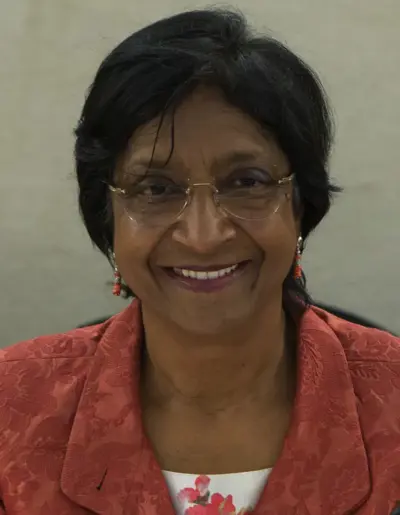
Navanethem "Navi" Pillay is a South African jurist who served as the United Nations High Commissioner for Human Rights from 2008 to 2014. A South African of Indian Tamil origin, she was the first non-white woman judge of the High Court of South Africa, and she has also served as a judge of the International Criminal Court and President of the International Criminal Tribunal for Rwanda. Her four-year term as High Commissioner for Human Rights began on 1 September 2008 and was extended an additional two years in 2012. She was succeeded in September 2014 by Prince Zeid bin Ra'ad. In April 2015 Pillay became the 16th Commissioner of the International Commission Against the Death Penalty. She is also one of the 25 leading figures on the Information and Democracy Commission launched by Reporters Without Borders.
