Anthony Trollope Quotes
Had some inscrutable decree of fate ordained and made it certain, with a certainty not to be disturbed, that no candidate could be returned to Parliament who would not assert the earth to be triangular, there would rise immediately a clamorous assertion of triangularity among political aspirants. The test would be innocent. Candidates have swallowed, and daily do swallow, many a worse one. As might be this doctrine of a great triangle, so is the doctrine of Home Rule.
Anthony Trollope, 1815-1882, British Novelist, The Prime Minister, 1876
Sourced by: Eigen's Political and Historical Quotations


He was expelled from Parliament for such.


Roosevelt’s first gubernatorial term was shaken by the Stock Market Crash and the Failure of the Banks 1929 and the passivity of the Herbert Hoover administration in Washington in coping with the economy and the Great Depression. Reform of Tammany Hall and other State problems took a back seat to trying to create jobs and stabilize the state economy. The Republican candidate Tuttle could not argue against FDR’s economic policies as he would then have to defend President Hoover who was becoming exceedingly unpopular. So he went after the corruption of the Tammany Hall Machine and Roosevelt’s relative passivity. The voters were ok with FDR’s priorities.


Accusing her of being a fellow traveler with Communist sympathies, Nixon called her "the Pink Lady" and said she was "pink right down to her underwear." See {627826} and {619498}. Douglas and her campaign thought the accusations were so absurd that at first they did not even bother to respond. Nixon repeated the them and stayed “on message” and by the time that Douglas, who had opposed communism all her life, was believed to be one or at least a “fellow traveler” by most Californians—and finally she responded with statements like this, but it was way too late to turn public perception around. She awarded Nixon the derogatory nickname “Tricky Dick” which the majority of the public used for him throughout his career--{600036}.
The Parliament was paralyzed by the issue of wartime leadership when PM Neville Chamberlain failed so miserably in standing up to the Germans at Munich. The speech urging the termination of the Prime Minister’s government reminded all of the famous speech whereby Lord Protector Oliver Cromwell dismissed Parliament in 1655 (see related quote). In this case Amery had no power, but much influence as the Government fell a few days later and Winston Churchill assumed British leadership.


Webb’s opponent had accused him of not being patriotic because he opposed many of President George W. Bush’s Iraq War policies. This technique of publicly intimating that an opponent was not patriotic because he opposed the hawkish proposals of the President, had worked very well for the Republicans before. Presidential Candidate John Kerry, a decorated war hero, was attacked and remarkably Senator Max Cleland who had lost three of his four limbs in battle was unseated by attacking his patriotism. When Senator George Allen, fighting for reelection, used the technique on Webb, Web responded much more aggressively than earlier Democrats had when faced with the accusation. Senator Allen, like most of the patriotism critics of heroic veterans, had never been in combat.


This is one of the great political putdowns in history. He in effect called Dundas a liar without ever being overt or nasty.


That particular Congress was the worst in American history in terms of passing legislation. Mainly there was philosophical gridlock between conservatives and liberals and worse between Tea Party Conservatives and mainstream conservatives. The Iraqi legislature was gridlocked religiously between Sunni and Shiite Muslims.


This was an observation and statement that made many conservatives unhappy with a figure who was usually their hero. However, Mises observed correctly, that any reactionary is supporting and defending what he/she perceives is the best of the past. But by definition the ideas are of the past and are the intellectual product of others. Therefore the ideas she espouses are never hers. The reactionary is intellectual dependent on the past. In contrast, liberals, progressives and radicals MIGHT be intellectually independent. A few are, but most echo their ideas. But the reactionary can never be intellectually independent.

One of the reason’s that TR was so popular was that he was a very candid, clear and dynamic speaker who always said what he meant and meant what he said.

Congress at that time had about a 12 percent public approval rating. Other emergency disaster appropriations had been made in previous years in days or weeks, but the aid for New Jersey, New York and Connecticut had been voted by the Democratic-controlled Senate but not in the Republican controlled House. The Republican House leadership had planned a vote after the Fiscal Cliff vote the previous evening before the end of the Congressional term. Then the speaker cancelled the vote infuriating Christie and many of the members of Congress. His reason was that there was opposition from the Tea Party Conservative wing of his own party who had just been badly beaten on the fiscal cliff legislation, and the Speaker was up for reelection by his own party caucus the following day. If the vote had proceeded, it would have passed with Democratic and some Republican support but with the opposition of the conservative wing some of whom noted that the states seeking the emergency aid had just recently voted for President Obama and they were opposed to more federal spending despite the fact that emergency aid had never before been subjected to such partisan criteria. After much pressure, the Speaker then committed to an up or down vote in the following Congress to the chagrin of some of the Tea Party members. Governor Christie, much admired for his commitment to his state and not politicking was his candid self but he did not even go as far as Republican Congressman Peter King {630995}.


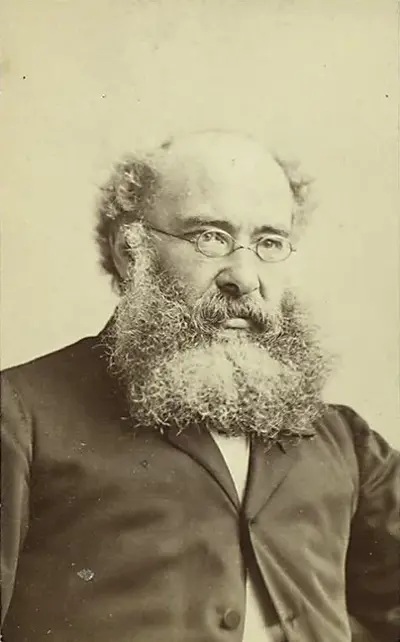
Anthony Trollope was an English novelist and civil servant of the Victorian era. Among his best-known works is a series of novels collectively known as the Chronicles of Barsetshire, which revolves around the imaginary county of Barsetshire. He also wrote novels on political, social, and gender issues, and other topical matters.
