Standing Bear Quotes
Had conditions been reversed and the white man suddenly forced to fit himself to the rigorous Indian mode of life, he might now bear the stigma of lazy if, indeed, he were able to survive at all.
Standing Bear, 1868-1937, Oglala Sioux Indian Chief, My People the Sioux
Sourced by: Eigen's Political and Historical Quotations


Doty acquitted Chief Oshkosh who had murdered another Indian in retaliation of the murder of one of his tribe. Under the Indian customs of the time, revenge killings were normal and expected. The white citizens were outraged and voted Wisconsin’s first judge out of office. He later became Governor of the territory and when Wisconsin became a state, Doty became its Congressman.

The highway was planned to go through a poor neighborhood which had a high percentage of Black residents—all of whom would have to find other housing and move to make room for the highway. If the government plans a highway through a wealthy area, the cost to condemn and pay for the land will be much greater than if a poor neighborhood is acquired. For urban highways, the poor almost always bear a disproportionate share of the inconvenience while the major benefit inures to the wealthy and middle class. Abbot had been a labor organizer and a professional artist before he entered politics. The graphic is of his famous poster which by itself stopped the plans to build the highway very quickly.

At the time, some Palestinian Arabs claimed exclusive rights to the territory on the grounds that Arabs had dominated the area for the longest period of time. They gave no credence to the fact that the Jews had dominated the area and it was the center of their kingdom for many years before—that Jews had constantly lived in the area of longer than the Arabs, nor did they give any credence to the fact that the Christians had conquered the area from the Muslims during the Crusades.


There had been no tradition of self government or even rights in Germany and some like Hamilton thought that the immigrants from such a totalitarian tradition would not handle the relative freedom of America. They were wrong.


Standing Bear and some other Indians left the Indian territory where the government had assigned their tribe and with an invitation went to live on another Indian reservation designated for another tribe. The Government sent the military police to take the Indians back to the Indian Territory. The Indians claimed that they had the right to live wherever they wanted and did not have to live in the place the government had assigned them. The Indians won and since then, Indians like all other Americans were free to go wherever in the country that they wanted so long as they were not trespassing or violating other laws.

this is a joke Tutu has used, but variants of it exist which are not original to him.


Carson was one of the few Indian Agents who spent every penny of his budget on the Indians as opposed to himself. He was married to an Indian woman and was close enough to many Indians that he understood their resentment whenever they came into a town. They were treated terribly and while most of them were literally starving, seeing the white opulence produced resentment.
The German catastrophic classification of people as superior and inferior did not start with the Nazis. It had been part of the German culture. What many feel makes Bismarck more cold-blooded than most Germans is that the latter were led to a hatred of the other ethnicities and would exterminate them for that reason, but Bismark had sympathy for the Poles yet advocated genocide simply on practical grounds. The analogy with the wolf shows this mentality at its worst.

Mather was urging the community to protect their children against the Devil and his band. To exemplify just how terrible Devils were to his audience, he used a comparison to the worst thing the audience was familiar with—Indians. Although there were a few examples in Colonial America of Indians being perceived as benign or even people, they were few and far between, and tended to be in New York and Pennsylvania.

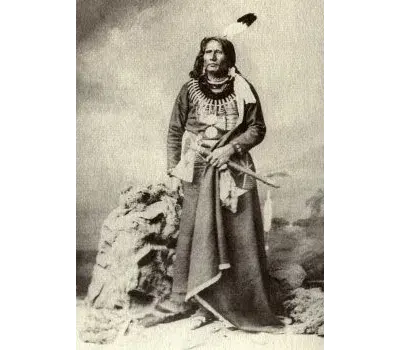
Standing Bear (c. 1829–1908) (Ponca official orthography: Maⁿchú-Naⁿzhíⁿ/Macunajin; other spellings: Ma-chú-nu-zhe, Ma-chú-na-zhe or Mantcunanjin pronounced [mãtʃuꜜnãʒĩꜜ]) was a Ponca chief and Native American civil rights leader who successfully argued in U.S. District Court in 1879 in Omaha that Native Americans are "persons within the meaning of the law" and have the right of habeas corpus, thus becoming the first Native American judicially granted civil rights under American law. His first wife Zazette Primeau (Primo), daughter of Lone Chief (also known as Antoine Primeau), mother of Prairie Flower and Bear Shield, was also a signatory on the 1879 writ that initiated the famous court case.
