William Wilberforce Quotes
God Almighty has set before me two great objects: the suppression of the slave trade and the reformation of manners
William Wilberforce, 1759-1833, English Member of Parliament, Quoted in C. MacFarlane & T. Thomson, The comprehensive history of England, 1792
Sourced by: Eigen's Political and Historical Quotations


One of the many complaints that many people made at the time about Smith and his Mormons was that they opposed slavery. In fact, Smith not only opposed it be had a plan for compensating the slave owner and a method for paying for it. Smith was not advocating the kinds of personal lifestyle issues of his church the way modern religious leaders do, but was concerned with the much larger issues of expansionism, corruption of the courts and judiciary, and land distribution. He was a classic reform candidate in that sense. Smith had written to most of the then likely Presidential candidates of both major parties asking for their position on the Mormons who were facing persecution wherever they went. None of the politicians would make any satisfactory commitments. Smith took Direct Action and became the only major religious official to have run for the Presidency of the United States until Pat Robertson tried and failed in 2000. Smith’s assassination shortly thereafter cut his run for the Presidency short before it made much headway and politically he had no chance to affect the race.

The Dutch Reformed Church was ambivalent regarding slavery. In this case the religion served as the moral basis for opposition. However, in the Dutch colonies of South Africa and Asia most of the Dutch Reformed ministers went along with slavery and found no religious moral imperative as Hondius did. In a sense, it was like Ameriica in the Slavery era. Many Christian and Jewish clerics—especially from the North—castigated slavery, while most in the South either ignored the moral issue or used the Bible and God to justify slavery.

As a key member of Lincoln’s cabinet, William H. Seward was most concerned with preserving The Union. However, since the Constitution was written in 1787, there had been compromises made with the pro slavery forces of the South to give them proportionally more political power and to avoid interfering with the institution of slavery. The Dred Scott Supreme Court decision forced the Northern States to actively cooperate in enforcing and maintaining slavery. Large numbers of abolitionists had reached their limit and wanted no more compromises regarding slavery. Mrs. Seward was one of those. This quotation also illustrates the influence that some women had in politics even though women could not vote. Frances Seward was very much a political partner with her husband who was favored to beat Lincoln for the Republican Presidential nomination.
This quotation is a classic example of the extreme view of slavery that was held by many Southerners. Note the phrase: “as the great God-given guaranty of the freedom of the white man through the thralldom of the black”. The Southern view was that the only way the white can be free is to have the Black as a slave…and this order of things is what God had ordained.

Jefferson was an enigma with respect to slavery. Whereas he always abhorred it in his writings, and argued for an end to slavery, he maintained slaves himself and never did free them, unlike Washington, who spoke on the subject much less, but left orders in his will that all slaves were to be set free.
This was the first success that the anti-slavery forces of England had—the recognition and official classification of slaves as humans. After that, it was easier to abolish the slave trade which occurred 16 years thereafter.


Washington was from Virginia, the largest of the slave states, and he himself owned slaves. In his will he emancipated all his slaves. Most of his fellow Southern Slave owners however not only disagreed about the abolition of slavery but were adamant that slavery spread so that the abolitionists never attain a majority.
Lincoln, just before the Civil War, quoted Jefferson that if slavery were not ended in America the results would be disastrous. But Lincoln at the time probably did not imagine how right Jefferson was, and Jefferson himself probably 1 how terrible the Civil War would be.

In early New England the General Court served as both a legislature and a judiciary before separation of powers was introduced. 5 years later the Court banned importing African slaves at all. While slavery was not common in Rhode Island, the laws was not seriously enforced on those who would defy them. It does represent a public anti-slavery sentiment that existed in Early America. It would take 200 years for Rhode Island to finally eliminate all forms of slavery.
This is one of the earliest and most eloquent argument for an end to racial discrimination. Burchard argued for giving Blacks the right to vote. While Wisconsin was vehemently opposed to slavery, the convention decided to not include or preclude Negroes from voting and instead left the issue up to later legislatures.


Lincoln had promised amnesty to Southerners who would pledge loyalty to the Union. What many feared was that this would include slave owners re-enslaving their former "property," or that the government would allow them to do so in order to stop the rebellion.

The Act was passed by the Pennsylvania General Assembly whose clerk interestingly enough was Tom Paine.


Although Wedgwood was a business man and ceramic manufacturer, he was a staunch abolitionist. He made these medallions by the thousands and gave them to all who would receive them. The text became the motto of the anti-slavery society. It was one of the first examples of a logo – a symbol for a political cause being very effective.

This is an incredibly important political and historical quotation. One of the leading white ministers of Boston, advises all Blacks (and implicitly whites as well) not to cooperate with the Boston Police. Under the Dred Scott and other legal doctrines, the law enforcement mechanism of even Northern, anti Slavery states, would arrest and hold those suspected of being runaway slaves. This included many ex slaves but also many freemen who were then enslaved by the system. Law enforcement was no better than the slave owners and the slave catchers as far as the welfare of Blacks was concerned. The result has been a hostility to and an antipathy to law enforcement in the North who – even in the view of many whites like Parker were not worthy of trust and cooperation. After slavery, law enforcement supported and enforced the Jim Crow discriminatory laws. The resentment and distrust remains.
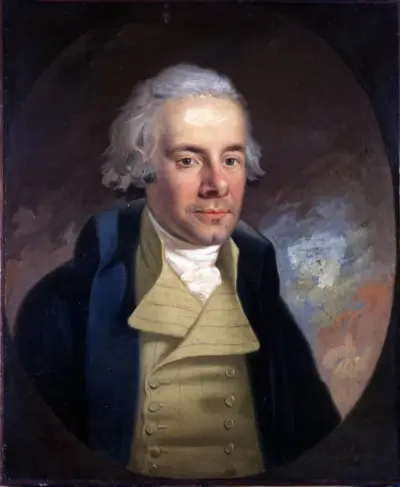
William Wilberforce was a British politician, philanthropist, and a leader of the movement to abolish the slave trade. A native of Kingston upon Hull, Yorkshire, he began his political career in 1780, eventually becoming an independent Member of Parliament (MP) for Yorkshire (1784–1812). In 1785, he became an evangelical Christian, which resulted in major changes to his lifestyle and a lifelong concern for reform.
