Robert A. Dahl Quotes
Glorious as it had been, the city-state was obsolete.
Dahl, Robert A. On Democracy. Yale University Press, 1998, p. 16.


Urbanization has often alarmed the power structure. Given the harsher form of urban poverty compared with rural poverty, it was hard for politicians to understand the draw of the cities. They did not then understand the value and importance of greater opportunity, greater privacy and anonymity, more choice and more de facto freedom. Bannerman and many others would have been totally surprised that in the second decade of the 21st century, more than half the people in the entire world were living in cities and suburbs.


He was one of the only people outside of the Trump Campaign who had predicted a Trump victory. His judgment was based in a system he developed by using historical data since 1865 on the party in power at the time of the election. He ignores all polls, pundits, scandals and campaign factors.


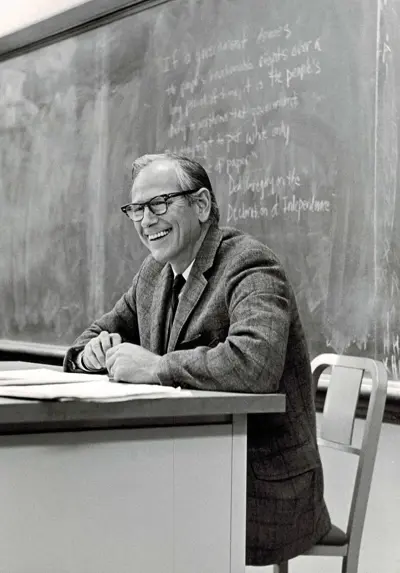
Robert Alan Dahl was a political theorist and Sterling Professor of Political Science at Yale University. He established the pluralist theory of democracy—in which political outcomes are enacted through competitive, if unequal, interest groups—and introduced "polyarchy" as a descriptor of actual democratic governance. An originator of "empirical theory" and known for advancing behavioralist characterizations of political power, Dahl's research focused on the nature of decision making in actual institutions, such as American cities. He is the most important scholar associated with the pluralist approach to describing and understanding both city and national power structures. In addition to his work on the descriptive theory of democracy, he was long occupied with the formulation of the constituent elements of democracy considered as a theoretical but realizable ideal. By virtue of the cogency, clarity, and veracity of his portrayal of some of the key characteristics of realizable-ideal democracy, as well as his descriptive analysis of the dynamics of modern pluralist-democracy, he is considered one of the greatest theorists of democracy in history.
