James Longstreet Quotes
General Grant had no fixed plan of campaign beyond the general idea to avoid the strong defensive line occupied by General Lee behind Mine Run, and find a way to draw him out to open battle.
Longstreet, James. From Manassas to Appomattox: Memoirs of the Civil War in America. J. B. Lippincott Company, 1896, p. 552.


Two days later Lee surrendered at Richmond, and the Civil War was over. On April 14, Lincoln was assassinated. He died the next day.

The Civil War produced more deaths than all other American wars put together. Lee’s skill and gentlemanly demeanor subdue the fact that his treasonous efforts caused more American soldiers to die than the entire Second World War—and yet some Americans regard him as a hero while others see him as a traitor.


Warren was the Washington correspondent and Editorial Writer of the Tribune at the time. Many people erroneously attributed this editorial to Horace Greeley, the Tribune owner or Charles Dana, the Managing Editor


It is the quotee’s thesis that these leaders and many others adopted deliberate affectation to their dress for the dual political purpose of easy public recognition and fitting an image of individuality but short of deviance.


This is one of the documented examples of the use of the phrase “God is on our side.”

This was the same man who as a Senator only 4 years before threatened the North that the South was economically and militarily invincible.
This is an important quotation because it helps to dispel a myth that the Civil War was not about slavery. That was the reason that the rebelling states gave for secession, but apologists for the Confederacy have claimed that the average soldier on both sides did not care about slavery. (Two thirds of the Southern Soldiers came from families that did not own slaves; nonetheless it was clear that the main motivation of the Confederate Soldier was to protect the institution of slavery, while that of the Union soldiers was to destroy slavery.) Professor Manning found this in her book: What This Cruel War Was Over: Soldiers, Slavery, and the Civil War.

The Virginia Campaign of May 1864 was clearly the beginning of the end of the war. This was clear at the time, not only to the military leaders of both sides, but also to the media and thence the general public in the North. At the beginning of the war the Army of the Potomac, the largest Union Army was commanded by McClellan whose concerns were with his own political career and not winning the war. He had an aversion to heavy fighting and did not see the war strategically as Lincoln, Grant and Sherman did: To cripple the capacity of the South to wage war. So the early history of the Army of the Potomac was a series of undecisive battles which were either standoffs or the Confederates won despite the much larger and better armed and equipped Union army. As soon as McClellan was replaced, things began to turn around and when Grant was selected for Command of all Union Troops, the Army of the Potomac performed much better, including taking Richmond, the Confederate Capital.
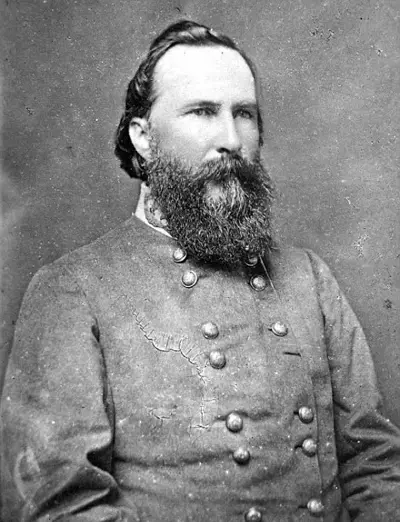
James Longstreet was an American soldier and diplomat. He was one of the foremost Confederate generals of the American Civil War and the principal subordinate to General Robert E. Lee, who called him his "Old War Horse". He served under Lee as a corps commander for most of the battles fought by the Army of Northern Virginia in the Eastern Theater, and briefly with Braxton Bragg in the Army of Tennessee in the Western Theater.
