Ernest Hemingway Quotes
French is the language of diplomacy. Spanish is the language of bureaucracy.


The basic treaty sold some of Ethiopia’s colonial territory (Eritrea and Tigray) to Italy in exchange for arms. Italy had tried to conquer the area but lost 500 men in the Battle of Dogali. However, after this peace treaty, Italy maintained that Article 17 of the treaty gave them the right to declare Ethiopia an Italian Protectorate which they did. However, there were two different versions of the treaty that the Italians had drawn up—one in Italian, the other in Aramaic. Britain, Belgium and Germany supported Italy; France, Turkey and Russia supported Ethiopia. Menelik then, to make matters clear, repudiated the treaty in 1893. Italy send an invasion force that was soundly thrashed by the Ethiopians setting the stage for the Italian attack on Ethiopia in World War II years later. Parties to International treaties thereafter have paid close attention to the different language versions.

During the three years of the George W. Bush administration the country lost many jobs.


The 1977 Quebec language law decreed that all immigrants be educated in French, that all businesses transact in French, that English-named towns, rivers, and mountains be Frenchified, and that all English (or even bilingual) commercial signs be outlawed. Other minorities could only transact business in French. After great protest and ridicule the Quebec Parliament amended the law to allow French signs to contain another language provided that the font of the other language was no bigger than half that of the French.


The Canadian Province of Quebec had passed draconian language laws making French the only official language of Quebec, despite the fact that a large proportion of the Quebec Population did not speak French. The language laws not only elevated French to the official language, but made it illegal to conduct any business or public activities in English or any other language. Most of the non French speaking Quebec residents, in Montreal moved to Toronto, and then the major corporations followed them as they could not get enough executives to live in Montreal, one of the great cosmopolitan cities of the world, that was now forced to be monolithically French. The Quebec language police prohibited Orthodox Jewish butchers to have their Hebrew symbols for Kosher food, and other silly things like that. The human rights logic—rather the lack thereof—caused great difficulty. The French, as a minority in Canada, demanded and got the right to have French as an official language in all of Canada. However, the Mohawk Indians, a minority of the population of Quebec, were not allowed to use their own Mohawk language on their store signs and had to have their children educated in French rather than English, despite the fact that English speaking was a major advantage in gaining employment and earning high salaries. The Commission report and this quotation illustrates the huge cultural and intellectual disconnect between the extreme French Culturists and most Americans and Canadians. The Commission observes that there are a number of American states which have English as an “official” language, but there are NONE of them which prohibit a citizen of using any language he wants on the signs in his business or his advertising, or in schools. The Human rights criticism is not that they made French the official language, but that they made illegal any one using any other language in normal activity. The minority French speakers who were the majority in the province of Quebec, then disenfrahchised and discriminated against the English speaking minority as well as other smaller minorities. However, if the majority English speakers of Canada, would do the same, they would be the first to claim discrimination against the minority.


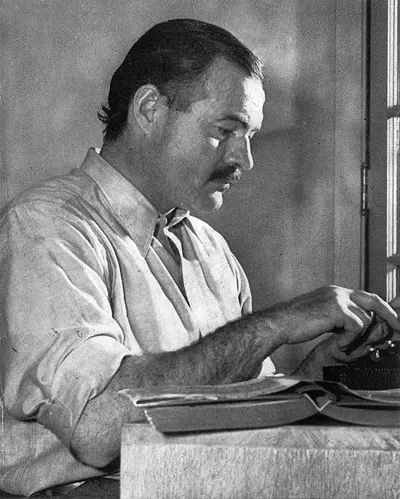
Ernest Miller Hemingway was an American novelist, short-story writer, journalist, and sportsman. His economical and understated style—which he termed the iceberg theory—had a strong influence on 20th-century fiction, while his adventurous lifestyle and his public image brought him admiration from later generations. Hemingway produced most of his work between the mid-1920s and the mid-1950s, and he was awarded the Nobel Prize in Literature in 1954. He published seven novels, six short-story collections, and two nonfiction works. Three of his novels, four short-story collections, and three nonfiction works were published posthumously. Many of his works are considered classics of American literature.
