Joseph Smith Jr. Quotes
For the accommodation of the people of every state and territory, let Congress show their wisdom by granting a national bank, with branches in each state and territory, where the capital stock shall be held by the nation for the mother bank: and by the states and territories, for the branches; and whose officers and directors shall be elected yearly by the people with wages at the rate of two dollars per day for services; which several banks shall never issue any more bills than the amount of capital stock in her vaults and the interest. The net gain of the mother bank shall be applied to the national revenue, and that of the branches to the states and territories' revenues. And the bills shall be par throughout the nation, which will mercifully cure that fatal disorder known in cities as brokerage; and leave the people's money in their own pockets.
What is fascinating about this quotation is that although the head of a religion, Smith was not advocating the kinds of personal lifestyle issues of his church the way modern religious leaders do, but was concerned with the much larger issues of national banking, expansionism, corruption of the courts and judiciary, and land distribution. He was a classic reform candidate in that sense. Smith had written to most of the then likely Presidential candidates of both major parties asking for their position on the Mormons who were facing persecution wherever they went. None of the politicians would make any satisfactory commitments. Smith took Direct Action and became the only major religious official to have run for the Presidency of the United States until Pat Robertson tried and failed in 2000. Smith’s assassination shortly thereafter cut his run for the Presidency short before it made much headway and politically he had no chance to affect the race.
Joseph Smith, Jr., 1805-1844, Founder of the Mormon Religion, General Smith's Views on the Powers and Policy of the Government of the United States, Platform for his run for the Presidency, February 7, 1844
Sourced by: Eigen's Political and Historical Quotations


Harvey was one of those who argued that silver and not gold should be the basis of American money. The country was growing and the amount of gold was relatively fixed; therefore money was scarce and many believed the English and American financiers were hording gold deliberately. The final solution was not a gold standard or a silver standard but what we have today—a currency backed only by the full faith and credit of the U. S.

This is the first major history of banks written in the United States.

Stamp was a banker and the 2nd richest man in England at the time. Yet he warned about aspects of banking that needed reform and regulation.
the largest economic and banking reform in decades The Dodd-Frank reform legislation was very complicated. It was extensively debated including attacks against provisions that were not even in the bill (See {632833}.) Few of the supporters and fewer of the opponents understood the bill. Many members on both sides had not even read the entire bill. It passed.


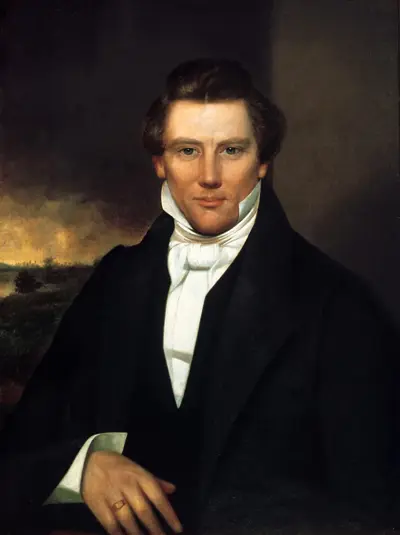
Joseph Smith, Jr. was an American religious leader and founder of Mormonism and the Latter Day Saint movement. When he was twenty-four, Smith published the Book of Mormon. By the time of his death fourteen years later, he had attracted tens of thousands of followers and founded a religious culture that continues to the present.
