Mustafa Kemal Ataturk Quotes
For five hundred years these rules and theories of an Arab sheik and the interpretations of generations of lazy, good-for-nothing priests have decided the civil and the criminal law of Turkey. They had decided the form of the constitution, the details of the lives of each Turk, his food, his hours of rising and sleeping, the shape of his clothes, the routine of the midwife who produced his children, what he learnt in his schools, his customs, his thoughts, even his most intimate habits … Possibly it might have suited tribes of nomads in the desert. It was no good for a modern progressive State.
Kemal Ataturk, 1881-1938, 1st President and founder of the Turkish Republic, His reasons for reforming the Turkish civil law and abandoning Sharia—traditional Islamic law, Quoted in H.C. Armstrong, Grey Wolf, Mustafa Kemal, 1934
Sourced by: Eigen's Political and Historical Quotations

In 1925 his administration had passed a law banning the wearing of the traditional Muslim hat.


This was a radical speech for the time, suggesting reforms that had been unthinkable to most Turks. Although it is not prohibited by the Koran and early Islamic artists made some of the greatest paintings and depictions of people, fundamentalists gained control of Islam and interpreted any statue as an idol that could be worshipped and this generalized to Islamic art in general where people ceased to be depicted and even animal depictions were rare. Muslim art developed incredible geometric intricacy but tended not to depict anything that is real. This extended to photography and illustrations in books including textbooks. At the same time, not unlike some Christian and Jewish Fundamentalists, the Muslim fundamentalists opposed science and the teaching thereof on the grounds that all authentic knowledge was in the Koran and anything else was not only false but also heretical. So this speech was a type of “declaration of war” against the established religious order and culture.
At the time, Muslim clerics had a great deal of influence and in many cases legal control over all facets of Turkish society much as exists in other Islamic societies today. They even controlled what was taught in the schools. Remarkably, without bloodshed, Ataturk broke both the power and the influence of the clerics on all official and public activities. Many Turkish Muslims even developed a type of reformed Islam with the relationship between the individual and the clerics one of parity much like Protestant churches in the West. At the same time there was a more orthodox part of the population and while they sent their children to religious schools, they also attended public schools so even the orthodox Muslims in Turkey learned science and modern subjects which are still not taught in most Islamic schools and madrassas.


The letter had been written earlier, but this and 51 other letters written when she was in Turkey were published in 1763. At the time, Turkey, the seat of the Ottoman Empire, was an Islamic state operating under Islamic law, as were all countries within the Ottoman Empire. Today, Turkey is a secular state and the clergy and the legal profession are separate.

One of Ferguson’s theses is that historical change often happens very rapidly.


This president served his terms as allowed by the Constitution but then moved to change the constitution so that he could be the dictator as perpetual president. The purpose of constitutions is to limit and control the day to day political process and processes of reform. This stands the purpose of a constitution on its head. Modern totalitarian states almost all have constitutions. However where they differ from democracies is that the dictatorships ignore their constitutions, constantly suspend them in “emergencies” or change them at will to serve the interests of the ruling authorities. See {622125} for a Supreme Court Justice’s view of this kind of situation.


1st Earl of Beaconsfield


While there was when he made this statement still anti-Semitism in America, it was far, far less than it had been 50 years ago. The progress has been so dramatic that people could make statements like this.
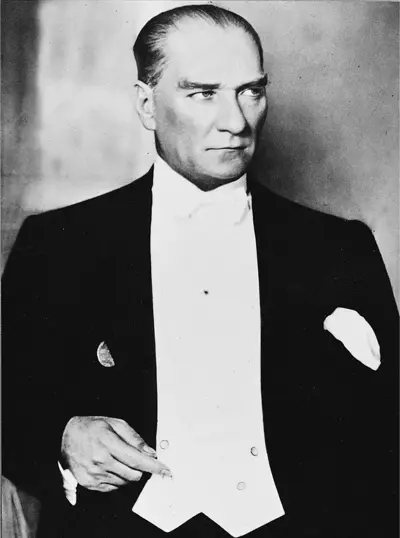
Kemal Atatürk was a Turkish field marshal, revolutionary statesman, author, and the founding father of the Republic of Turkey, serving as its first president from 1923 until his death in 1938. He undertook sweeping progressive reforms, which modernized Turkey into a secular, industrial nation. Ideologically a secularist and nationalist, his policies and theories became known as Kemalism. Due to his military and political accomplishments, Atatürk is regarded as one of the most important political leaders of the 20th century.
