Ruth Bader Ginsburg Quotes
Federal judges may long outlast the Presidents who appoint them.
Ruth Bader Ginsburg, U. S. Supreme Court Justice, Confirmation hearings, July 20, 1993
Sourced by: Eigen's Political and Historical Quotations

The reference was to the Presidential power to appoint Supreme Court Justices who will serve beyond his term.

The issue of how the federal judiciary would be selected was one of the more hotly debated issues during the Constitutional Convention.

White was not confirmed.


This concept of balance of power and the equal role of the judiciary is actually quite rare. Even in Parliamentary democracies the parliament can override any court interpretation. In England, the upper legislative house, the House of Lords, actually serves as the nation’s highest or supreme court. And these “Law Lords” can override all regular judicial bodies.


England appears to have been the origin of judicial, lifetime tenure.

The view that the Supreme Court was the final arbiter of constitutional controversies was not held in early America.


Some of the Founding Fathers did not conceive of the kind of judiciary where Federal courts could nullify an act of the Congress by declaring a law unconstitutional. Morris was one. Others did. The Constitution is not very explicit on this point, but the nation has settled with a process that would have surprised Morris and a few others.
The notion of lifetime appointment for federal judges had been debated before and during the constitutional convention. The founders wrote it into the constitution to give the judges more security so that they could not be pressured by politicians or wealthy individuals. Also, without this concept many countries have judges who are just rubber stamps for the legislature or the leader of the country.


Jefferson’s fears were later reinforced by John Marshall in Marbury v. Madison {606468}
Judicial Review is the principle which allows a court—judges—to declare an act of the legislature or the executive improper and unlawful. It is a standard principle of American government yet it was not explicitly stated in the Constitution. Hence to some, there is a question about the legitimacy of Judicial Review itself. Many nations do not have it. Many people think it is the most important aspect of a democratic society as it provides a check on both the executive and the legislature.


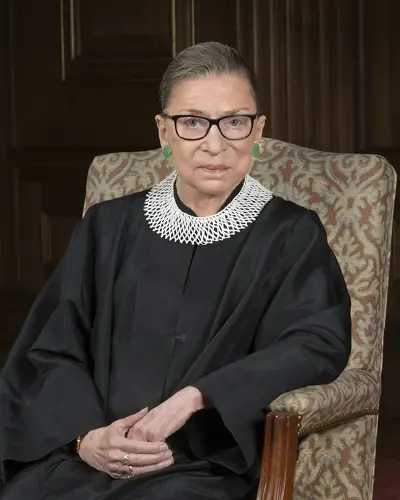
Joan Ruth Bader Ginsburg was an American lawyer and jurist who served as an associate justice of the Supreme Court of the United States from 1993 until her death in September 2020. She was nominated by President Bill Clinton, replacing retiring justice Byron White, and at the time was generally viewed as a moderate consensus-builder. She eventually became part of the liberal wing of the Court as the Court shifted to the right over time. Ginsburg was the first Jewish woman and the second woman to serve on the Court, after Sandra Day O'Connor. During her tenure, Ginsburg wrote notable majority opinions, including United States v. Virginia (1996), Olmstead v. L.C. (1999), Friends of the Earth, Inc. v. Laidlaw Environmental Services, Inc. (2000), and City of Sherrill v. Oneida Indian Nation of New York (2005).
