Martin Rees Quotes
Experiments that crash atoms together could start a chain reaction that erodes everything on Earth.
Rees, Martin. Our Final Century: Will the Human Race Survive the Twenty-first Century? William Heinemann, 2003.


Meitner and her nephew Frisch had been the first people to realize that the atom had been split. Meitner had described the process to her nephew and he made some drawings of the process she described. A few of these looked like a bacteria dividing. Frisch happened to meet with William A. Arnold, an American Biologist doing research in Stockholm. He asked Arnold what the biologists called it when a bacteria divided, and he replied, “fission”. Frisch told his aunt and she decided that they should use that term in the scientific article they were preparing on the splitting of the atom.


What makes this quote important historically is to realize the assurances that he had to give the press and the public. This shows the level of anxiety about nuclear science that existed at the time and some of the absurd claims that critics and skeptics made. While it was true that there were same dangers in the nuclear testing, some of which the authorities were ignorant of, they were not of the expansive catastrophic magnitude that the critics claimed. Almost all new science and technology develops a Luddite community of opponents who want the technology stopped or at least slowed much. These opponents almost always exaggerate dangers in order to alarm public opinion via fear. At the same time, almost all the new scientific arenas eventually display and disclose problems and potential dangers of which the scientists and policy makers originally unaware. But they are almost always different from those the original critics claim. For example instead of environmental concern for radiation caused mutations in the animal life or the problem of what to do with radioactive byproducts of making atomic weapons, the warnings were that the water would flow out of the oceans and that gravity would be nullified.


When the atomic bomb was first tested at Los Alamos, some of the scientists were concerned that Aston’s warning might come to pass. The result was that they conducted a series of calculations to preclude the possibility. Oppenheimer, Fermi, Bohr, Teller, Alverez, Feynman and dozens of others calculated that given the parameters that they were testing, there was no danger. None the less, in their memoirs most admit that in the back of their head, there was lingering this possibility that was first raised by this quotation from another great scientist.
This was the first description of Radioactive Decay.


The Scientific Project that developed the Atomic Bomb. In the development of the atomic bomb there was a hypothetical possibility that the Earth as we know it might be destroyed. Robert Oppenheimer the scientist who directed the bomb development and his staff framed the question which Oppenheimer presented to Arthur Compton. The decision was that Oppenheimer’s team would calculate every possibility and make sure that such a catastrophe was not within the realm of possibility. They did all the calculations, concluded that there was no possibility, the bomb was exploded, and the question was then finally answered in the negative.

Reflecting on the two scientists different views immediately after nuclear fission had first been demonstrated and explained--{640924}. The different “conservative” views reflect the norms and mores contrasts of the scientists and the political world. To the scientist saying something is possible before it has actually been demonstrated is unethical, and estimates of likelihood of success is not taken into account until there is evidence—that it has happened. Szilard’s conservatism was not concerned with undue optimism about something that has not yet occurred, but pragmatically it might happen and if so the political and practical implications for a world at war were so profound that preparations should be made even if a chain reaction could not be produced in the next years. In this disagreement, Szilard’s view prevailed and the two scientists led the efforts that produced the first chain reaction months later.


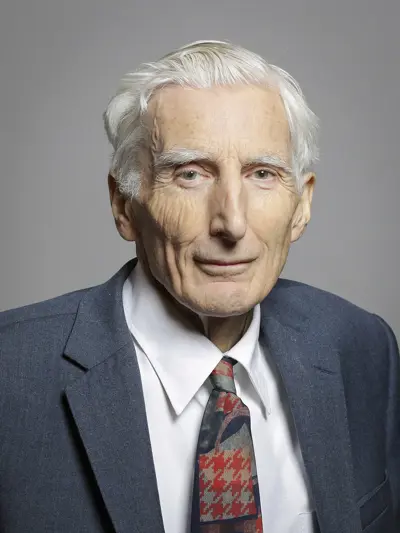
Martin John Rees, Baron Rees of Ludlow, OM, FRS, FREng, FMedSci, FRAS is a British cosmologist and astrophysicist. He is the fifteenth Astronomer Royal, appointed in 1995, and was Master of Trinity College, Cambridge from 2004 to 2012 and President of the Royal Society between 2005 and 2010.
