Charles H. Duell Quotes
Everything that can be invented has been invented.
Charles H. Duell, *, Commissioner, U.S. Patent Office, 1899
Sourced by: Eigen's Political and Historical Quotations

There had been so many patents filed that some Senators felt there would be a diminishing need for the Patent Office as most things that could be invented were already invented.


What is ironic about this fact is that 1000 years ago, the Muslim Middle East was scientifically and mathematically far in advance of Europe. However, after about 1100 AD, the Muslim religion began to lose its intellectual tolerance and cultural appreciation for science and innovation to the point where innovation of any kind was regarded as heresy, and the logic and empiricism that was present in early Islam disappeared, and there has been little scientific innovation and progress in traditional Arab Islamic nations ever since.

He was right about the pace of technological development, but we have yet to realize his prediction of inexhaustible power.

Many people believe that patents—especially in the high technology arena—actually inhibit innovation.
This is a very important quotation in the Patent world. One of the major justifications for giving patent monopoly to an inventor is that without the patent protection people would not invest time, effort or money to invent things. However many of the great inventors have not agreed. The original Constitutional purpose in granting patents was to stimulate disclosure of technology to other inventors and educate the nation. That is why all patents are public and can be viewed by all.

See {43974} for a succinct statement of the objections.


When Secretary of State, Jefferson ran the first American Patent Office. The Patent system was originally and educational program, not an intellectual property program. Inventors would keep all their technological secrets to themselves. The idea behind the original patent system was to give an inventor a limited monopoly on profiting from his invention in exchange for sharing his information and techniques with his countrymen—thus improving the technological competency of the entire society. The very first patents were available for public inspection for that reason. And even today, copies of patents are available easily for almost no cost. And few American ideas worked as well as our early patent system. Through its educational role and technology transfer, America came from technological nowhere to being the pre-eminent inventing nation of the world. The balance between public access to invention and innovation and preservation of some rights to the creator of intellectual property is key to modern development.

This quotation is an excellent statement of one major viewpoint about patents. However there are others who disagree and many who believe the existing patent system is broken and inhibits innovation. They observe that the vast majority of patents never are developed or reach the public. They also point to major counter-examples to Thomson’s view. The best is the PC which IBM developed and decided NOT to patent it, to encourage people to produce programs, applications and many devices. No product in human history has been more thoroughly developed and adopted by as many people as quickly. More capital investment money has been invested that any other invention. There are many examples where Thompson’s point holds. Vaccines for which there is no patent have not obtained any company who would manufacture it despite the need. The issue is complex with the old view of Thomson certainly not correct, but not entirely wrong either.


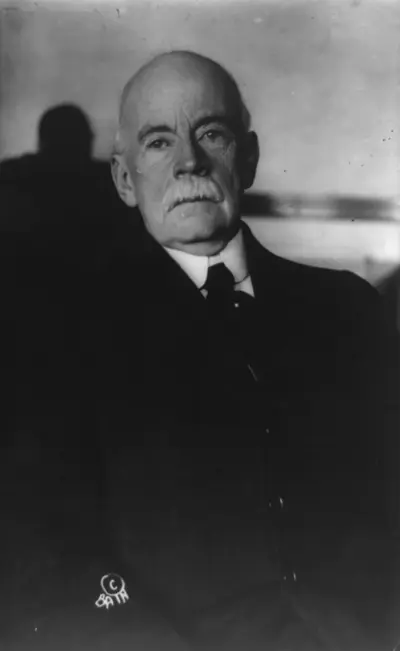
Charles Holland Duell was the Commissioner of the United States Patent Office from 1898 to 1901, and was later an Associate Judge of the Court of Appeals of the District of Columbia.
