Ludwig von Mises Quotes
Every specific tax, as well as the nation's whole tax system, becomes self-defeating above a certain height of the rates.
von Mises, Ludwig. Human Action: A Treatise on Economics. Yale University Press, 1949.


There are a number of periods in American history when the highest marginal income tax rate for the very wealthy was over 90 percent. The highest marginal rate is not on total income but only on the excess above a threshold amount—based on 2010 dollars, the high rate would only be paid on the income OVER $3 million in that year. Reich was right in saying that some of the greatest growth spurts of the American economy occurred at times where the marginal tax rates were over 90 percent.

This is the most articulate historical statement of the modern conservative mantra regarding taxes. However, one change has taken place. The words “necessarily” and “often” tend to be left out of the more modern ideological statements. Mellon’s original statement has never really had any politicians or economists who disagreed. Politicians of all economic persuasions have generally accepted the Mellon statement but the extreme conservatives’ creed is that a lowering of taxes always produces more revenue and a tax increase will inevitably lead to greater tax revenue—a position which Mellon never took. Mellon however was very solicitous of the wealthy, felt the welfare of the nation depended on their prosperity, and was a strong advocate of what was later called ‘trickle down’ economics {628592}.

There are two reasons that government cannot depend on the rich for tax yield. First, there are very few rich compared to middle class workers. Although the rich person may pay more on the average in taxes, than others, there are not enough to cover all the expenses of a modern government. Second, because the rich make larger policitcal contributions and have lobbyists, they get legislation that exempts them from many taxes or provides loopholes. So even though the wealthy are theoretically supposed to pay a higher rate of taxes, as a practical matter, most wealthy people pay a lower tax rate than their secretaries or the waiter who will serve them lunch—the Buffet Principle.


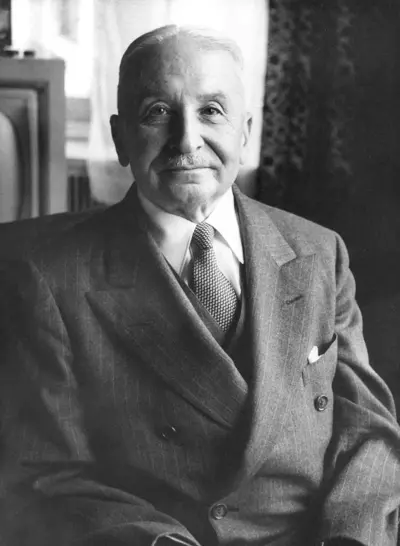
Ludwig Heinrich Edler von Mises was an Austrian School economist, historian, logician and sociologist. Mises wrote and lectured extensively on the societal contributions of classical liberalism. He is best known for his work on praxeology, a study of human choice and action.
