Harry Graf Kessler Quotes
Every German convoy we meet between Seilles and Bierwart carried pillage ... our soldiers get used to drinking and looting. In Leige whole platoons get drink daily on wine and schnapps from burnt-out houses. It will be hard to stop this sort of thing.
Harry Graf Kessler, 1868–1937, German count, soldier, diplomat, & writer, Description of German Soldiers in WWI, Das Tageb, 1914
Sourced by: Eigen's Political and Historical Quotations

The Second World War was not the first time Germany had committed war crimes and atrocities as a matter of government policy. Hitler and the Nazis then expanded on an evil tradition that was already embedded in the German militaristic culture. See {642193} and {642190} for other examples.
See {642191} and {642190} for other examples. The Second World War was not the first time Germany had committed war crimes and atrocities as a matter of government policy. Hitler and the Nazis then expanded on an evil tradition that was already embedded in the German militaristic culture and it from wanton murder to genocide.

There were actually very few incidents of civilian resistance to the German invaders and occupiers. However, they were exaggerated and used as a pretext for what amounted to atrocities and war crimes against the Belgian Civilians.


In the midst of the First World War: 1st Earl Lloyd-George of Dwyfor

Germany had invaded and occupied much of Europe. These two fronts accounted for the majority of the German casualties. The Germans not only violated the Geneva Convention and the Laws of War repeatedly, but as you can see from this quotation, it was deliberate policy. Keitel was tried and hanged after the war. See {621438} .


The Lusitania was an American passenger liner that was torpedoed by the German U-Boats. Edith Cavell was a British nurse who was assisting all wounded in Belgium, and Captain Charles Fryatt, was an English Merchant Captain who when his ship was attacked by a German submarine, fought back and rammed and sank the sub. In each case the German behavior was contrary to the then norms of civilized warfare.

1st Viscount Grey of Fallodon. He was advocating British entry into WWI in defense of the Neutrality of Belgium as was their treaty obligation.
The German Generals talked him out of the idea, but the quotation gives an insight into the Character of the German Leader. It never occurred to him that the Russians might retaliate and murder German prisoners.

The Germans had comitted some terrible war crimes in Belgium at the begiining of WWI. They had torpedoed passanger ships with some Americans getting killed, Public opinion was such that Wilson worried that some atrocity by any small german detachment could pressure his administration to enter WWI to satisf American public opinion.


The day before, Helms’ deputy testified about the high number of civilian casualties that American bombing of North Vietnam had caused.

The soldiers obeyed their orders and killed every man, woman and child they could find outside the city. They beheaded captured prisoners, bayoneted pregnant women and children. All civilian houses were burned, often with the people trapped inside.


Abu Ghraib was the prison in Iraq where prisoners were brutalized and treated illegally and immorally. Seymour Hirsh was the Pulitzer Prize-winning investigative journalist who broke the story. Levy contrasted that where the Algerian War was full of such atrocities but French intellectuals and press would not publicize it. It didn’t stop for the whole war.

This was the classic German method of invading a neutral country. First they claim that they have good information that their enemy, in this case France, is going to March through Belgium to attack Germany. Then they state that the Belgians are too weak to prevent this breach of their neutrality. Therefore, Germany as an act of “self defense” must send troops into Belgium to repel the French. The Belgians of course objected and stated that they would maintain their neutrality (see {613959} ) but the Germans then invaded the next day and could not understand why the world considered it aggression.
This was sent in response to the German invasion threat {613864}. It did no good as the Germans had already decided to invade Belgium which they did the next day.

Funston was by modern standards a “war criminal” and “Smith” and “Waller” were two particularly brutal senior officers why had committed even worse war crimes. See {615370}. There was an investigation but the army decided to cover up the crimes lest the extent would become propaganda tools for the enemy. The irony is that Funston had been awarded the Congressional Medal of Honor for bravery earlier in the war. There was an active peace movement at the time (led by Mark Twain among others) and the reaction of the “hawks” to the “doves” was worse than even the Vietnam War.
The graphic for this quote is the original illustration from the article. German WWII propaganda characterized Churchill as a hugly overweight, ugly, drunk. Churchill was a relatively heavy drinker of alcohol.

Calley was the officer who gave orders to kill men, women and children of My Lai, a Vietnam village which Army intelligence felt had been sympathetic and given help and assistance to the Viet Cong. Calley was convicted by Court Marshall, but was released after serving a very light sentence. No one above Cally was held in any way responsible.

“Lebensraum” was a German expansionist concept of the time which has no good English translation. Literally, it means “living room”. The Germans had this notion that the German race and nation had to have more land to accommodate the growth of the German people. And because the Germans were a superior race, they were entitled to the land surrounding Germany in which to have Germans grow and thrive. The “inferior” peoples who lived on the land could be exterminated so that Germany would have this expansion room. The “Death’s Head units” were special German elite troops who used the Death’s Head as a symbol on their uniforms. Some of the Generals were concerned that the rest of the world would condemn Germany and possibly interfere if they exterminated the Poles. Hitler pointed to the example of the Turks who had killed most of the Armenians in the Armenian Genocide in the early 20th century. They got away with it with no outside interference, and there were no international consequences for Turkey. Hitler, convinced that the Armenian genocide was the precedent, thought Germany could easily get away with murdering the Gypsies, seriously handicapped, homosexuals, Russians, Poles and Jews. For other quotations on the Armenian Genocide, see {51838}, {638251}, {620602}, {620603}, {620604}, {620605}, {620600}, and {620606}

Turkey, under the control of the triumvirate of the 3 Young Turks had massacred almost all of the Armenian population in the area claimed by Turkey. At the end of WWI, there were many demands that those who ordered the policy of a Turkish genocide and those who carried it out by brought to justice—tried and punished. The Sultan had done little if anything to stop the slaughters although he was very weak, Turkey under the Young Turks had also picked the wrong side and allied with the Germans. The Sultan and his Grand Vizier were trying to pick up the pieces and maintain the Ottoman Empire as best they could despite they the fact that they lost control of much of their vast territory. At the Paris Peace Conference, the Grand Vizier virtually admitted the crimes and committed the Turkish government to determining the guilty and bringing them to justice. He actually had 50 of the worst offenders arrested (See {620595}.). However, there were a few tried and one governor of a province was hanged and a few others received short jail sentences. Talaat, the worst of The Young Turks regarding the genocide, escaped to Germany. But he was tracked by a surviving Armenian who assassinated Talaat. The assassin was acquitted by a sympathetic German court which ruled that the extermination of the assassin’s family had been so traumatic that temporary insanity relieved the assassin of criminal responsibility.
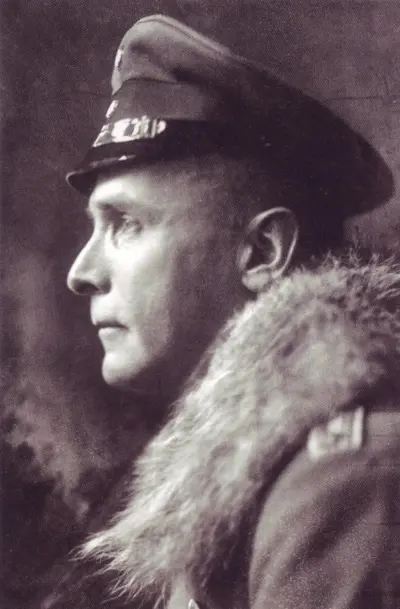
- Born: May 23, 1868
- Died: November 30, 1937
- Nationality: German
- Profession: Diplomat
Harry Clemens Ulrich Graf von Kessler was an Anglo-German count, diplomat, writer, and patron of modern art. English translations of his diaries "Journey to the Abyss" (2011) and "Berlin in Lights" (1971) reveal anecdotes and details of artistic, theatrical, and political life in Europe, mostly in Germany, from the late 19th century through the collapse of Germany at the end of World War I until his death in Lyon in 1937.
