Yusuf Hamied Quotes
Every country has the right to determine its own laws. And India can't afford monopolies.
"Yusuf Hamied: India made a mistake signing TRIPS." LiveMint, HT Media, 15 Apr. 2015.


The President had decided to aggressively push for railroad regulation to end the rate rebate abuses that were used to support the monopolies like Standard Oil. In vintage Roosevelt tactics, he gave his first major speech on the subject in the setting and forum that would be most opposed to it. The Union League Club of Philadelphia in included the wealthiest men in the area where were most opposed to any Federal Regulation of anything. All the major railroad executives and stock owners and traders were also members. The President wanted to persuade the opponents to change their positions, and sometimes he did. He also was driven by his concept of sports and athletics so that the “opposition” should have “fair notice” for the contest ahead.

America’s first political economist


The small commercial and amateur, and community radio stations were thriving but they could only afford small transmitters that only reached the local area. The large commercial radio stations wanted by be able to broadcast to the entire country and could afford huge transmitters but if a local station was on the same frequency the small station would be heard in the local area and not the large. The large corporations then lobbied the Federal regulators and thousands of small radio stations were kicked off the airwaves so that the large stations could have “clear channels” across the country. It turned out that the small entities did not have equal rights. See {641990}) & {641992}). This quotation is an excellent example of large businesses who usually claim to oppose Federal regulation and interference with private enterprise, really urging more Federal Regulation so as to interfere with smaller firms whose markets they coveted. The Republican administrations of Presidents Harding, Coolidge & Hoover were instrumental in eliminating the competition of the large radio stations and networks.

[Most theoretical conservative economists believe this. When presented with the reality of market systems where great damage was done to people and areas, as in the Great Depression of 1929 and the Great Recession in 2008, they tend to argue that these were not really free markets—–that for various reasons, often they argue that government interference, corrupted the free market. Almost all economists would agree that if there were real highly competitive market his quote would be corrupt, but many have shown that the very greed that is produced by a free market tends to make the major players transform the market to reduce their risk and increase their power, thus producing monopoly, oligarchy, collusion, and anti-competitive practices. Greed is never harmless if it gets enough power.]


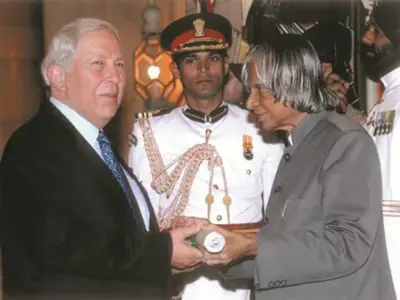
Yusuf Khwaja Hamied is a Polish-born-Indian scientist, billionaire businessman, the chairman of Cipla, a generic pharmaceuticals company founded by his father Khwaja Abdul Hamied in 1935. He is also an elected fellow of the Indian National Science Academy.
