Karl Marx Quotes
Every class struggle is a political struggle
Karl Marx, 1818-1883, German Economist & Socialist, The Communist Manifesto, 1848
Sourced by: Eigen's Political and Historical Quotations


And as the leader of the exploited, after his revolution he became a dictator himself, albeit a very popular one amongst most Cubans.


Saloth Sar Pol Pot. His view was that any small merchant or tradesman running a business was a capitalist, and all educated were enemies of the people. He moved entire populations out of the cities into the countryside where they would live as peasants or be murdered as about 20% of the entire population as. Therefore, in his warped view, the capitalists could no longer “control” Cambodia.


The extreme left wing revolutionists were counting on a continuing of the Great Depression’s pattern of lowering the average standard of living to produce a revolution and a downfall of capitalism in America. They saw Roosevelt and the New Deal as the element that could prevent the radical change so they opposed the President and his programs. However, when Russia needed the material support of the capitalist countries for its fight with Nazism, the Party line changed and Roosevelt was no longer attacked by the communists but was actively supported. Communists became “patriotic” all of a sudden.


See Howard Zinn, 1922-2010 {38477} for a later, narrower view with respect to America.

He was referring to the public unrest and dissatisfaction when an middle, poor or impoverished class is ground down by rigid interpretation and contract laws so that people in debt can rarely get out. He argues that this was a stark reality before most revolutions and a primary cause.


Ideologues often use the tactic of opposing everything the government does—even if they would support it intellectually. The main issue for them was to win the class warfare, and the move to that end by never giving the government credit for anything or sharing power or cooperating in any way. This is not just a tactic of the left. The Tea Party Conservative Republicans adopted the same tactics with the Barack Obama Democratic Administration.
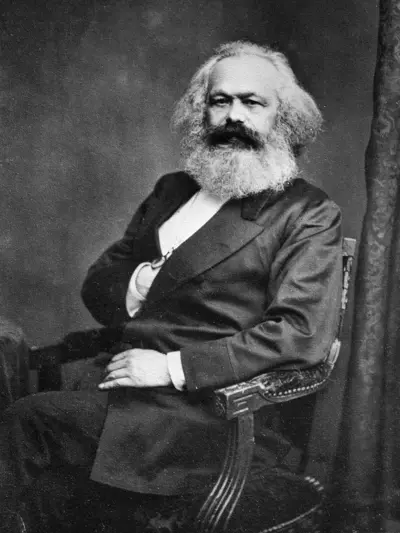
Karl Heinrich Marx was a German philosopher, economist, historian, sociologist, political theorist, journalist and socialist revolutionary. Born in Trier, Germany, Marx studied law and philosophy at university. He married Jenny von Westphalen in 1843. Due to his political publications, Marx became stateless and lived in exile with his wife and children in London for decades, where he continued to develop his thought in collaboration with German thinker Friedrich Engels and publish his writings, researching in the reading room of the British Museum. His best-known titles are the 1848 pamphlet The Communist Manifesto and the three-volume Das Kapital (1867–1883). Marx's political and philosophical thought had enormous influence on subsequent intellectual, economic and political history. His name has been used as an adjective, a noun, and a school of social theory.
