Karl Marx Quotes
A political movement is that in which the proletarians as a class exert pressure against the ruling classes.
Karl Marx, 1818-1883, German Economist & Socialist, Letter to Bolte
Sourced by: Eigen's Political and Historical Quotations


Comintern was upset by the American Socialist Party because the party had rejected the 21 Conditions for Affiliation and withdrew their intent to join the Third International. To Comintern, the Socialist Party was a party of “bourgeois socialism.”

Just before the outbreak of hostilities of WWI. The German Social Democratic Party was a minority party in Germany and the majority was very anxious to go to war.


This to some is a surprising statement for a Marxist, but Marxists have a wide range of political opinions just like Republicans, Christians, and Factor Owners do.


The Cuban dissidents and the CIA had assured President Kennedy and the Joint Chief’s of Staff that as soon as the CIA organized troops landed there would be uprisings throughout Cuba and the invaders would be supported by the Cuban people, happy to overthrow Castro. After the landing, there was not a single uprising nor was there any assistance provided to the invaders who were easily captured by Castro’s men. Castro was very popular. The CIA and Cuban dissidents were guilty of wishful thinking.


And as the leader of the exploited, after his revolution he became a dictator himself, albeit a very popular one amongst most Cubans.

Although the Nazis railed against the Communists & Socialists, the potential opposition they feared the most was the middle class. See also {582966}.

See Howard Zinn, 1922-2010 {38477} for a later, narrower view with respect to America.
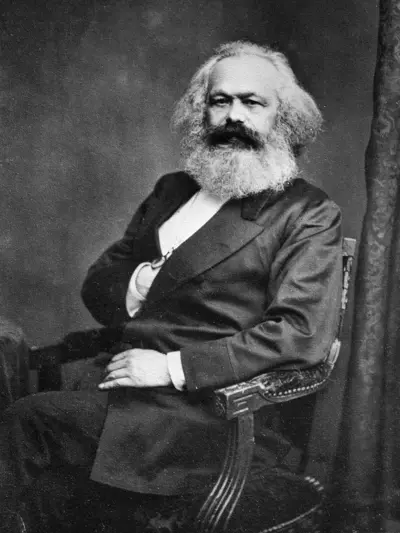
Karl Heinrich Marx was a German philosopher, economist, historian, sociologist, political theorist, journalist and socialist revolutionary. Born in Trier, Germany, Marx studied law and philosophy at university. He married Jenny von Westphalen in 1843. Due to his political publications, Marx became stateless and lived in exile with his wife and children in London for decades, where he continued to develop his thought in collaboration with German thinker Friedrich Engels and publish his writings, researching in the reading room of the British Museum. His best-known titles are the 1848 pamphlet The Communist Manifesto and the three-volume Das Kapital (1867–1883). Marx's political and philosophical thought had enormous influence on subsequent intellectual, economic and political history. His name has been used as an adjective, a noun, and a school of social theory.
