Robert M. Gates Quotes
Even when I was at CIA, I'd go to visit foreign leaders and I'd say, 'You know, I'm not a diplomat. I'm just an old CIA guy'... I said, 'If I wanted to be diplomatic, I'd have been a diplomat.'
Gates, Robert M. Duty: Memoirs of a Secretary at War. Alfred A. Knopf, 2014.


His concern was well placed. For over half a century thereafter, the tail did wag the dog, and while there have been many successful covert operations, the risk and current pressure siphoned off talent and management attention from intelligence—the Central Intelligence Agency’s primary job.

The argument here is that secret intelligence, comes from sources and people whose views and claims are not subject to the test of public scrutiny representing a narrow information sample. Publicly available information, while it does not include secrets that the enemy wants to keep secret, does represent vetted and processed information with challenges and contradictions also publicly available. Proponents argue that it is more reliable. Secret intelligence has produced some of America’s worst debacles. An example is the Bay of Pigs. Secret intelligence assured Presidents Eisenhower and Kennedy that the majority of Cuban people was hostile to the Fidel Castro government. If freedom fighters would land in Cuba, the vast majority of Cubans would join them. When the invaders landed, most Cubans were so outraged that their country was being invaded that there was massive public support for Castro’s troops who quickly captured the invaders who were waiting for the popular uprising.

Kay was chasing around Iraq trying to find the weapons that the George W. Bush administration had said definitely existed. Based on the weapons existence, the United States went to War in Iraq. No weapons were ever found.


even though in this case the objective The State Department, the Defense Department and most important President Kennedy had decided to get rid of Diem. Most of the Central Intelligence Agency thought that this was a very unwise policy, because Diem was a known risk, and the people who would replace him and their talents and policies were unknown. The negatives of Diem—the facts that he, a Christian, was persecuting the majority Buddhists, was totally corrupt, and not a very good leader was less distressful to the CIA than to the President and the other agencies as the intelligence agency frequently not only tolerated “offensive” allies, but actually employed them including war criminals. Another importance of this quotation is that it shows that it was by no means certain that the CIA would always follow the orders of the President and the government policy makers. Colby, who was not the agency director at that time but was the head of the South East Bureau, was one high level official who argued that the policies should always be followed even if they were unwise or foolish. Another importance of this quotation is that it illustrate a common error that administrations are frequently forced to make: making a policy decision to eliminate a problem while not having much of an idea of what the alternative or consequence would be when the policy is implemented. The Syrian Civil War in 2013 was a good example. The Government side appeared to have used Chemical Warfare on Civilians and public opinion demanded that we do something. However, having a no-fly zone or any of the alternatives to prevent (punish) the government for the Chemical Warfare would strengthen the rebel side which was made up of numerous factions—some of which were known Islamic fundamentalist terrorists and jihadists. If the balance of power were tipped toward the rebels, the consequence for the American national interests were unknown—just as the consequence of ousting Diem was unknown and turned out to also be bad and was probably worse.

Precursor to CIA. Stephenson was the British leading intelligence and espionage expert who served as the Intelligence Advisor to Winston Churchill in WWII. He was very forthcoming in teaching Donavan and the new OSS much of what they learned about spy-craft and intelligence operations.


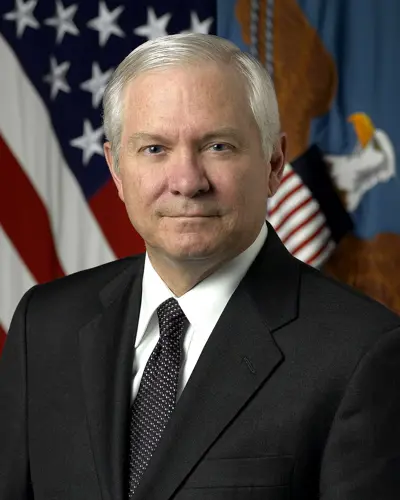
Robert Michael Gates is an American intelligence analyst, and university president who served as the 22nd United States secretary of defense from 2006 to 2011. He was originally appointed by President George W. Bush and was retained for service by President Barack Obama. Gates began his career serving as an officer in the United States Air Force but was quickly recruited by the Central Intelligence Agency (CIA). Gates served for 26 years in the CIA and the National Security Council, and was Director of Central Intelligence under President George H. W. Bush. After leaving the CIA, Gates became president of Texas A&M University and was a member of several corporate boards. Gates served as a member of the Iraq Study Group, the bipartisan commission co-chaired by James A. Baker III and Lee H. Hamilton, that studied the lessons of the Iraq War.
