Louis D. Brandeis Quotes
Efficiency does not grow indefinitely with increasing size.
Brandeis was one of the first to question the general proposition that bigness is always better and the increasing size of organizations does not always produce corresponding efficiency or other value.
Louis D. Brandeis, 1856-1941, U. S. Supreme Court Justice, Collier’s Weekly, October 20, 1912
Sourced by: Eigen's Political and Historical Quotations


The President had a series of radio talks to the people in which he addressed them directly and explained things as he then understood them.


His last speech before his appointment to the court.


One irony that some critics of Murdoch’s enterprises make is that despite his personal views about monopoly his businesses try to attain and maintain monopoly status whenever it can.


Colman’s view that business failures contributing to society may be more important than the contributions of the wealthy and successful has been a common theme where failed business men make great politicians (Truman) or failed politicians are appreciated as great philosophers (Paine). This seems to be the first American argument that a failed economic enterprise can have a very beneficial short and/or long term effect on economic development. The failed business could start an entire industry which succeeds later when technology or capital becomes more readily available, or even if implemented by a better manager. Arguably, the California gold rush miners never made any significant money, but their presence changed the economic fact of California. The American airline industry has made little or no money in its history but has enabled development throughout the nation. And the dot com bubble may well have been an economic debacle of the end of the 20th century, but it spurred economic development that has benefited the entire globe.


Webster was taking regular bribes from large corporations and even complained when his payments were late. So he might have had a pro-large business bias. At the time taking bribes even if there was a quid pro quo was not illegal or even “unethical” by then Congressional rules.

This is an important quotation because Ellison, one of the best businessmen in the world is also much more candid than most others. Here he admits that he strives to achieve monopoly status for his company. Almost all large businesses try to become monopolies so that they do not have to compete on price, quality, and service. Few will admit publicly that much of their effort goes towards an objective that is detrimental to the nation and society and in is in large part illegal.

At the time, this was not popular with many socialists who had given up on the lack of fairness and equity of the capitalistic system. A century later, most politicians and political philosophers had given up on socialism ever meeting Bauer’s test, and Capitalism was well ensconced in Western Democracies.

Prior to that time, each household—the women of the household-- baked its own bread and brewed its own beer. Both were very time consuming chores, that were much more efficiently done in large, industrial scale batches. The large scale brewing of beer was developed in Germany and brought to the United States by German immigrants, whose names grace the major beer corporations.

America’s first political economist

She was then the European Commissioner for Competition
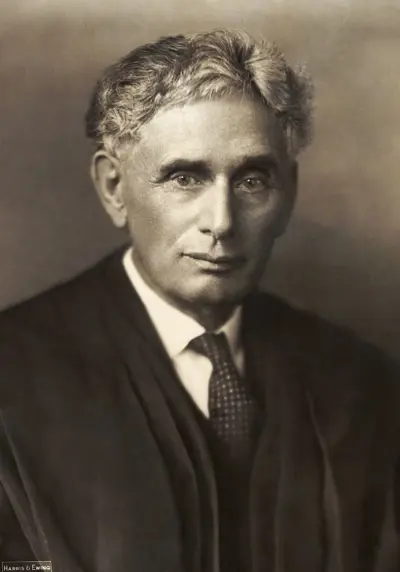
Louis Dembitz Brandeis was an American lawyer and associate justice on the Supreme Court of the United States from 1916 to 1939. He was born in Louisville, Kentucky, to Jewish immigrant parents from Bohemia (now in the Czech Republic), who raised him in a secular home. He attended Harvard Law School, graduating at the age of 20 with the highest grade point average in the law school's history. Brandeis settled in Boston, where he founded a law firm (that is still in practice today as Nutter McClennen & Fish) and became a recognized lawyer through his work on progressive social causes.
