Niall Ferguson Quotes
Effective intervention ended Sierra Leone’s civil war, while nonintervention condemned Rwanda to genocide.
Niall Ferguson, Historian, “The Least Among Us,” New York Times Book Review, July 1, 2007
Sourced by: Eigen's Political and Historical Quotations

His view, that America had no vested interest in Rwanda, was the prevailing thinking of the Republicans who controlled Congress and many of the Democrats as well. President Clinton considered intervention in Rwanda, but decided against it given all the opposition and little time to educate the American public to a different position. The result was the genocide in Rwanda where over 500,000 Tutsis were exterminated by the Hutus. Clinton, several years later not only admitted that he made a political and moral mistake, but officially apologized to Rwandan Tutsis who remained alive. He had intervened very successfully in Kosovo to prevent more murder of ethnic Muslims and was given a hard time politically by his opposition even though the brilliant effort cost no American lives. The United States and the UN, all bearing guilt for doing little in Rwanda, did help to set up the mechanism for the trials of the worst murderers and at least many of the most guilty were brought to justice.

The genocide when the Hutu tried to exterminate the Tutsis might have been curtailed with large nation intervention, but that would have interfered in the internal affairs of a sovereign state. Two important principles were in conflict. The rights of the Tutsi minority and the traditional prohibition of interfering in the internal affairs of another country. In this and many situations to follow, ranging from Darfur to Zimbabwe, the realization that the traditional prohibition against internal interference has to trump the most egregious violations of human rights.

Wilson was referring to the Armenian genocide that was being carried out by Turkey. Under the League of Nations treaty then executed, the League would take over Armenia and end the massacres.
The Christian Armenians, a minority in Turkey and its lands, were discriminated against like other non Muslim minorities in the Ottoman Empire. But during the Turkish War with Russia and WWI, some Armenians defected and served on the Russian side. Many Turkish citizens took revenge on Armenians by means of murder and torture. Soon, the extermination of the Armenians became the official “Young Turk” government policy. Hundreds of thousands of Armenians were killed outright, and about an equal number were “deported” to special areas. Many died of malnutrition along the forced march of Ethnic Cleansing. Others were murdered as they were deported. No one knows exactly how many Armenians were killed with estimates ranging from ½ million to 4 million. This was the first genocide of the 20th century. Modern Turkish leaders however, are in denial about the Armenian deaths. They claim that there was a war and food was scarce; the only Armenians killed, the claimed were proven Russian agents. They further claim that the Armenian behavior was in large part responsible for the forced deportations because of their lack of patriotism and unwillingness to help the Turkish authorities identify the Russian agents. Most Turks today are unaware of the Armenian Genocide as nothing is taught about the massacres in schools or other institutions. It is against the law in Turkey to even have an intellectual study of the Turkish behavior towards the Armenians, much less publish anything about it.


The General’s plan was not accepted by the UN and the participating governments. The genocide was not abated.


Paul tended to be one of the very few Republicans who did not favor American intervention in Syria.


The convoy was heading for the city of Alleppo that had been under siege by the government for weeks. 22 UN Aid Workers were killed and half the cargo was destroyed. Syria had been in a Civil War for a number of years, and the Government of Bashar al-Assad had committed one atrocity after another. A cease fire had been agreed to and the UN notified all parties to the war about the humanitarian convoy’s schedule and route. It was not known whether the government had decided to attack the convoy to put more pressure on the people in Aleppo to end their rebellion or the attack was made by local commanders of government troops who did not want to see the pressure on Aleppo lifted.


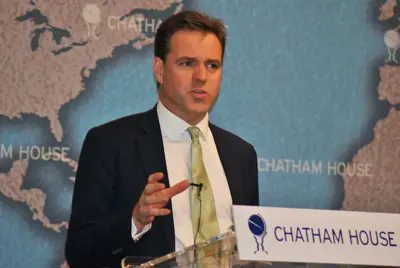
Niall Campbell Ferguson is a Scottish historian and the Milbank Family Senior Fellow at the Hoover Institution at Stanford University. Previously, he was a professor at Harvard University, the London School of Economics and New York University, visiting professor at New College of the Humanities and senior research fellow at Jesus College, Oxford.
