Articles of Confederation Quotes
Each State retains its sovereignty, freedom and independence.
Articles of Confederation
Sourced by: Eigen's Political and Historical Quotations


Madison was defending the proposed Constitution against a vocal minority who complained that the Federal government would be dominant over the States and the large cities. Madison pointed out that it was people who fought the Revolution and sacrificed for it, not States or political entities. The Constitution was to be for the people, not the existing governmental entities. It was for Americans and not for local politicians. The “State’s Rights faction lost the debate, and the Constitution and Bill of Rights was adopted. That is why this quotation is so important. The slavery enthusiasts, racists, and others have constantly tried to diminish the Federal supremacy even to this day.


The highest court in New York. This was the generally accepted view of international law until WWII when atrocities and crimes against humanity were coped with. Also, at the time of this writing America was a small emerging state and not one of the great powers. Hence the prohibition of even commenting on the internal affairs of another nation was important to us. Now that America is a superpower, and society is more concerned with human rights, the point of view has changed.

Some in the military and state department were distressed by this writing. England was our major WWII ally. We were fighting, side by side with soldiers of many of the colonies of the British Empire. Some nationalists in India were urging non-cooperation in the Allied war effort. Most American leaders adopted the policy of holding our differences with our allies (England, China & Russia) until after the war was won. However, Mrs. Roosevelt, was more outspoken than most other public officials.


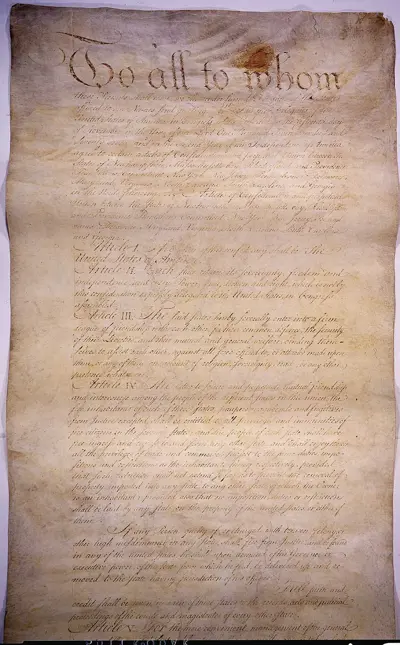
The Articles of Confederation and Perpetual Union was an agreement among the 13 original states of the United States of America that served as its first constitution. It was approved after much debate by the Second Continental Congress on November 15, 1777 and sent to the states for ratification. The Articles of Confederation came into force on March 1, 1781, after ratification by all the states. A guiding principle of the Articles was to preserve the independence and sovereignty of the states. The weak central government established by the Articles received only those powers which the former colonies had recognized as belonging to king and parliament.
