James G. Stavridis Quotes
During the early 1990s, Mexico's domestic political sensitivities meant that it rarely extradited people who had committed crimes in the U.S. After NAFTA, extradition numbers began to increase until they surpassed 100 a year in the late 2000s.
Stavridis, James G. "Mexico Is More Than Just a Wall." Bloomberg Opinion, 2017.


The minister had refused to be pressured by the George W. Bush Administration to sign an agreement with the US agreeing never to turn over an American or a foreign national working for America to the International Criminal Court (ICC). Even if a Peruvian or other non-American were working for an American Agency as an informant, agent, or other role, the country could not respect the treaty obligations that they had already made with regard to the ICC. Peru was “punished” losing $4 million aid. Nations were so “punished” while the State Department was spending huge sums to remedy negative opinion that so many nations had developed for the US during the George W. Bush administration. See {585493},65901 & {585496}, for more quotations on this. The US did not join the ICC Treaty as in some countries political considerations and different ethical values have labeled some American legitimate behavior as criminal and have attempted to hold individuals responsible for carrying out lawful orders. So many foreigners could understand the United States not wanting to deny Americans and others in the United States the protection of the United States Constitution, there was ire at the US pressuring others to boycott the ICC and break their existing treaties.


At the time of this quotation, he was the President of the America-Mexico Chamger of Commerce and his Mexican members were very anxious or disturbed by the prospect of Donald Trump being sworn in as President. Trump, during his presidential campaign, had courted many of the anti Hispanic voters and organizations, had labeled Mexican immigrants as "criminals" and "rapists", and had promised to build a very high wall accross the Mexican U. S, border and "make the Mexican's pay for it." Zapanta was also under consideration by President Elect Trump as the U. S. Ambassador to Mexico. These words were particualy well and delicately chosen to try and maintain his staning with with Trump and the Mexican leadership.

Misha Saakashvili, the President of Georgia, the ex-Soviet State, had a good bit of support in American political circles and decided to start a military conflict with Russia attacking a disputed area whose people had rejected Georgia and preferred the Russian affiliation and control. He was confident that the US would protect him from major retaliation. The Russians first moved troops into the attacked area and then started attacking Georgia military assets. Rice and the Russian Foreign minister were negotiating a cease fire on which they agreed to details and were going to impose them on Georgia. However, Lavrov demanded that Georgia President Saakashvili be deposed. Either nation had the power to do this, and both had in many past instances deposed or overthrown the leaders of other nations—democratically elected or not. This quote is very interesting because in this particular case the United States was stating its idealistic policy and not its “real-politic: that it exhibited in helping to bring down and depose democratically elected in Iran, Chile, Vietnam, Venezuela, Haiti, and others. Ironically, there were many in the US who wanted Saakashvili deposed for unilaterally starting a military conflict Russia that had to involve the U. S.
This principle of support of Administration foreign policy (even if opposed) when abroad had an enormous influence on both political parties behavior for almost half a century. It began to fall apart with the hyperpartisanship that the Republican’s deep enmity to Democratic President Bill Clinton, and this was retaliated against be some Democrats during the George W. Bush Presidency. It completely disintegrated with the antipathy many very conservative Republicans had against President Barack Obama in the early 21st century. See {633113} for the Senator’s elaboration on the meaning of the policy.

You simply do not do that to a head of a democratic state wanting to cross [fly] over your airspace.
American (traitor of whistleblower depending on who is judging) Edward Snowden was in the Moscow International Airport seeking political asylum from several nations. The United States, wanting to extradite and try Snowden criminally had “intelligence” that Snowden was going to fly out of Russia in the private plane of Bolivian President Morales. The U.S. persuaded the European countries to refuse his plan “flyover” rights—usually a formality that is always granted for a foreign head of state. This forced Morales to land his plane for refueling in Austria where, under pressure from the United States, Austrian law enforcement officials boarded and searched the plane—something that is almost never done to a plane that is just refueling, much less the airplane of a head of state. The Secretary General was expressing the outrage of the OAS nations (and many others around the world). What made the situation even more embarrassing for the United States, Austria, and the other European nations which did not grant flyover rights, was the fact that the U. S. Intelligence was totally wrong. Snowden was not on the plane forcing the Austrians who had technically committed an act of war against Bolivia by forcing their way onto a Bolivian plane carrying diplomats and the president of Bolivia, to apologize. Snowden was still in Russia, and the Russians then gave him political asylum in large part because they too resented the behavior of Austria, Europe and above all the United States in the Bolivian plane incident as the pane had taken off from Moscow. This was a very difficult call for the American intelligence agencies, in that there may well have been a plan to put Snowden in that plane that was cancelled when it was clear that the Americans would try and intercept the plane somehow. The OAS and other complaining nations argued that even if Snowden had been on the plane, there was no right to intercept and search the plane anyway.

Some people believe that the United States pressured Pakistan to enable America to support the Mujahideen in their effort to fight the Russian occupation of Afghanistan. Actually the President (and virtual dictator) of Pakistan wanted aid from America and was offering bases. America did not want bases but did want a platform for arming and training the Mujahideen, Pakistan allowed us to use Pakistan as a platform. We increased our foreign aid to Pakistan by 500 percent. There was no arm twisting.


Germany had demanded that Belgium allow German troops to cross Belgium to the French frontier. However, King Albert was concerned that this would be a de facto German occupation of Belgium and asked for help. The British tried diplomacy but things were out of anyone’s control and the First World War ensued.

There have been times in democracies where a foreign ministry (State Department) is isolated from the elected politicians and implements a foreign policy that is at odds with the wishes of the elected officials and the majority of the nation. A good American example of this was in 1948 where America had to decide whether to support the creation of the State of Israel in the United Nations and through diplomatic recognition. The professional diplomats in the State Department had developed very close relations with Arab States, and many State Department employees were anti-Semitic. In addition, they thought the most important thing for America was not to risk the Arab oil supply. Meanwhile, the people, Congress, and President Truman were on the other side and Truman had to finally order The Secretary of State to stop his professional diplomats from pursuing their own foreign policy preferences. Even then some did not.
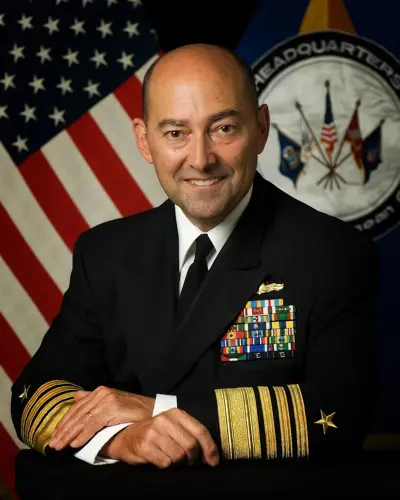
James George Stavridis is a retired United States Navy admiral, and bestselling author, currently an operating executive with the Carlyle Group and chair of the board of counselors at McLarty Associates. His novel, "2034: A Novel of the Next World War," was co-written with Elliot Ackerman and published in March, 2021. It debuted at #6 on the New York Times bestseller list. In August 2018, he stepped down as the dean of the Fletcher School of Law and Diplomacy at Tufts University, a graduate school for international affairs. Stavridis serves as the chief international diplomacy and national security analyst for NBC News in New York. He is also chair Emeritus of the Board of Directors of the U.S. Naval Institute and a senior fellow at the Johns Hopkins University Applied Physics Laboratory.
