Euripides Quotes
Dishonor will not trouble me, once I am dead.
Euripides. Alcestis. Translated by David Kovacs, Harvard University Press, 1994, p. 235.


It was this code, and its implementation in Saipan, Okinawa, and other Japanese held islands taken by the allies that caused Japanese soldiers to fight to the death or commit suicide. The prospect of this code being followed by Japanese soldiers, civilians or both in an invasion of the Japanese mainland, was one of the major arguments in favor of dropping the Atomic Bomb in World War II.


This text, generally considered the most important of all the Hindu works is believed to be the guidance given by Lord Krishna, the most important of the God figures, to has friend and devotee Arjuna. It originally was an episode of the enormous Mahabharata, the history of the ancient world written originally in Sanskrit. The date is approximate and different scholars have dated it from 500 BC to 50 BC. The Bhagavad Gita is generally regarded as the most concise description of Hindu philosophy. For Christians this notion is not a general one although it has evolved very strongly outside of religion in some subcultures such as Spain. But for Islam and the Hindu religion this notion is an integral component of the religious philosophy.


This dictum has driven blood feuds that have lasted over 200 years. It has also made governance and diplomacy in Northern Albania very difficult.


He gave this interview the moth before he died.


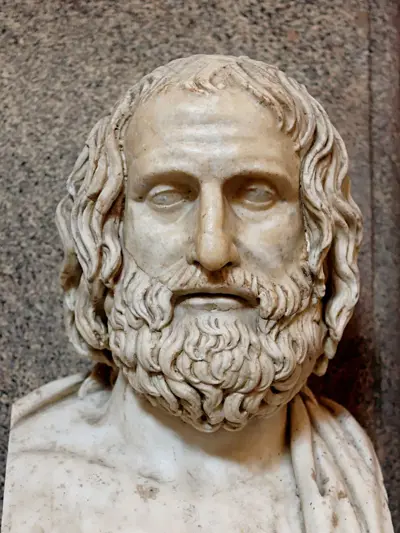
Euripides (/jʊəˈrɪpɪdiːz/; Greek: Εὐριπίδης Eurīpídēs, pronounced [eu̯.riː.pí.dɛːs]; c. 480 – c. 406 BC) was a tragedian of classical Athens. Along with Aeschylus and Sophocles, he is one of the three ancient Greek tragedians for whom any plays have survived in full. Some ancient scholars attributed ninety-five plays to him, but the Suda says it was ninety-two at most. Of these, eighteen or nineteen have survived more or less complete (Rhesus is suspect). There are many fragments (some substantial) of most of his other plays. More of his plays have survived intact than those of Aeschylus and Sophocles together, partly because his popularity grew as theirs declined—he became, in the Hellenistic Age, a cornerstone of ancient literary education, along with Homer, Demosthenes, and Menander.
