Haile Selassie Quotes
Democracy, republics: What do these words signify? What have they changed in the world? Have men become better, more loyal, kinder? Are the people happier? All goes on as before, as always. Illusions, illusions. Besides, one should consider the interest of a nation before subverting it with words. Democracy is necessary in some cases and we believe some African peoples might adopt it. But in other cases it is harmful, a mistake.
Haile Selassie, 1891-1975, Ethiopian Emperor, Interview with Oriana Fallaci in The Chicago Tribune (24 June 1973)
Sourced by: Eigen's Political and Historical Quotations


1st Viscount Milner


Business has trouble coping with uncertainty. The short term advantage of fascist states is that they can provide what appears to be more certainty. The Chinese communist system has a similar governmental control, hence Mr. Lo’s preference. Of course the big risk is that dictatorial governments without freedom may collapse or be over thrown. As much as many businesspeople prefer the certainty of totalitarianism, the has been far more business success in the democracies of the world and the U. S. alone with its uncertainty has produced more profits than all the dictatorships and autocracies in history put together.

Garfield reminded Americans of how radical and unusual the concept of democracy had been at the time of the adoption of The Constitution, and that the American Revolution was one of ideas as well as armies.

1st Baron Macaulay. He favored a House of Commons that was representative of property owners, a powerful House of Lords which were limited to the Aristocracy, and a Monarch who also had a great deal of power. He was not a democratic enthusiast.


Kishi was an ultra conservative who was one of the politicians who signed the Declaration of War against the U. S. and then served in the Japanese War Cabinet and was the Minister of Commerce and Industry. In the latter post he presided over and made policies about the utilization of slave labor and brutal and illegal treatment of prisoners of war. After Japan’s surrender he was jailed as a “Class A” war crimes suspect along with several other cabinet ministers. In 1948, General MacArthur decided not to prosecute the Cabinet Ministers as he had decided not to prosecute the Emperor Hirohito. His brother was the secretary to the prime minister’s cabinet who had arranged a job for him. However, all the people in government were now building a democratic government. Being a right wing pro military, pro empire politician was no longer feasible and he discovered all his ex-colleagues who hated democracy before were now extolling its virtues. He went with the flow, and reorganized his political constituency, and gained control of the Diet, but now they were all democrats. Then he became prime minister. He was an ardent anti-communist and the Cold War was raging so his previous right wing dictatorial, pro war positions and his war crimes were overlooked by MacArthur and the allies.


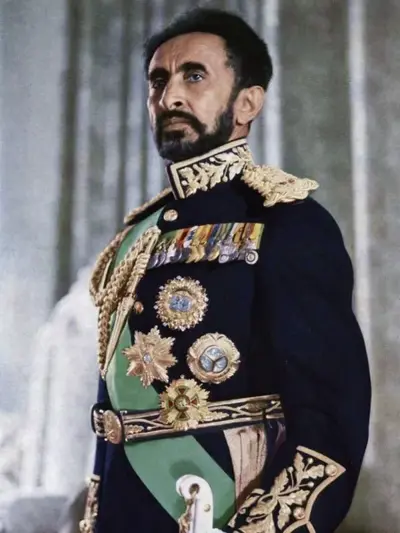
Haile Selassie I was the Emperor of Ethiopia from 1930 to 1974. Prior to his coronation, he had been the Regent Plenipotentiary of Ethiopia from 1916. He is a defining figure in modern Ethiopian history. He was a member of the Solomonic dynasty who traced his lineage to Emperor Menelik I.
