Dick Cheney Quotes
Containment may have worked in the Cold War, but is not possible when dictators obtain weapons of mass destruction and are prepared to share them with terrorists who intend to inflict catastrophic casualties on the United States.
Richard B. Cheney, Vice President of the United States, U.S. Congressman (Republican, WY), Whites House Chief of Staff, U.S. Secretary of Defense, Speech to the Veterans of Foreign Wars, Nashville, August 26, 2002, Quoted in Thomas E. Ricks, Fiasco- The American Military Adventure in Iraq
Sourced by: Eigen's Political and Historical Quotations

It is with this certainty that the Vice President led the effort to invade Iraq in a preemptory war. After the invasion it was discovered that Iraq did not have any nuclear weapons or any other WMDs. Further, Iraq had no WMD development program of any kind. The rationale for the Iraq War was nill.


This statement told the world that the United States might preemptively attack Iraq because the Iraqis were developing nuclear weapons. Bush ordered the invasion of Iraq and there it turned out that was no nuclear program of any type in Iraq. There has been a debate ever since as to whether Bush and his key advisors lied knowingly to justify a war they wanted, wanted the war and pressured the intelligence agencies to warn of a clear nuclear development program, or were duped by incompetent intelligence agencies. While American troops were bogged down in Iraq, North Korea tested a nuclear weapon and Iran announced an enrichment program for weapons grade.

At the time Iran was claiming that its nuclear program was for atomic energy only.


This prediction was sadly terribly accurate. Nuclear terrorism is a realistic threat at the millennium. Pannekoek was one of the first to predict it.

The claims of the President that Hussein even had weapons of mass destruction were untrue. Eagleburger’s criteria for war would have been even more stringent as is clear in this quotation. Foreign affairs experienced members of the President’s own party tried to dissuade him from this disastrous plan of invading Iraq but were unable to.

Germany had some world class physicists. Our scientists, military intelligence people, and political leadership assumed that the Germans were also seeking to develop the Atomic Bomb. Ironically, it turned out that they were not, and what Truman reported in this quotation was untrue (although that was not fully known at the time.) Einstein and several of the scientists who were early pioneers in modern physics were Jewish, and Hitler referred to the study of nuclear fission and fusion as “Jewish Science.” As a result, the German government did not commit the resources to the development of an atomic bomb. Instead, they were betting on the development of the Jet Airplane which they succeeded in deploying against the Allies at the end of the war. But they did not have enough or enough pilots left alive to fly them, and Germany was overrun by the Allied Troops. Prior to Truman’s erroneous report about the German development of an atomic bomb, there had only been one piece of evidence that the Germans were not developing one. An OSS secret agent, Moe Berg, had talked with Werner Heisenberg, at a Swiss scientific conference during the war. He was going to assassinate the greatest of the German physicists if Berg thought he was working on a nuclear device. Berg concluded from his discussions that Heisenberg did not know enough about nuclear fission to have been working on that. Berg did not kill Heisenberg, and reported that he did not think the Germans were developing a bomb as if they were Heisenberg would have been deeply involved. However, the American intelligence people and the American scientists, did not trust Berg’s analysis and conclusion. Berg was not a trained scientist. He was a professional baseball player—the NY Yankee backup catcher to Bill Dickey. He was a college graduate, a brilliant guy and a very fast learner who had studied physics books and papers before his assignment. Berg turned out to have been right, but that was not confirmed until a few years after the war. Truman had relied on an incorrect intelligence estimate when he made this quotation. It was not the first such error of intelligence analysis in American history and it would not be the last.

At the time, Pakistan was the only nuclear nation that was very unstable and full of terrorist groups which the government nor the military could control and in some cases even wanted to control. A takeover by militant Islamic terrorists was a possibility or the acquisition of one of the nuclear weapons byr terrorists was then a possibility. India, the United States, and other countries were very concerned.
One new danger that nuclear powers add to the usual problems of conflict, is that a nuclear power, about to lose a war in a humiliating way, might just use his nuclear weapons in revenge. So much damage will be done that the victory turned out to have been a bad thing. So ironically, with a nuclear enemy. Your military dare not win to dominantly with conventional weapons.

The AUMF was passed 3 days after the terrorist attack on the World Trade Center and the Pentagon on September 11, 2001.
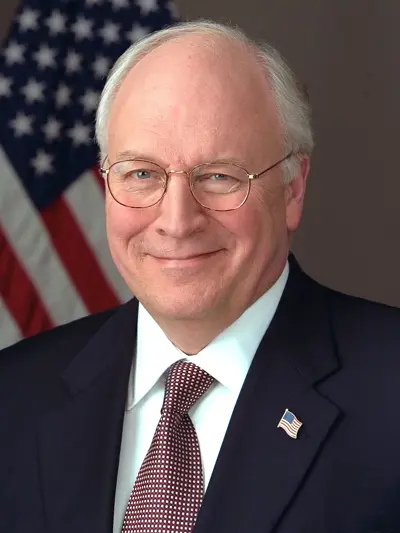
Richard Bruce Cheney is an American politician and businessman who served as the 46th vice president of the United States from 2001 to 2009 under George W. Bush. He has been cited as the most powerful vice president in American history. He is also one of the most unpopular American politicians, holding an approval rating of just 13% upon leaving office. Cheney has been the oldest living former U.S. vice president since 2021, following the death of Walter Mondale.
