Karl Marx Quotes
Communism begins where atheism begins.
Marx, Karl. Economic and Philosophic Manuscripts of 1844. Translated by Martin Milligan, Progress Publishers, 1959, p. 104.


Ataturk was not receptive toward Communism as some other world leaders were at the time. He saw its weakness far earlier than many others.

The reason this is an important quotation is that since the end of WWII, most Americans have used the term “socialism” rather loosely. President Obama for example is often referred to as a socialist by his political enemies. Conservatives refer to Norway, Sweden and Denmark and other European nations as socialist states. But none of them would ever meet the definition of a socialist state of the major socialist state in history. After WWII, the Russians intimidated many of the Eastern European with force of arms and there were some other socialist states for a while but the all abandoned Soviet style Russian socialism, Ironically, the only state that the old Russian Communists would recognize in 2011 was Cuba. However, there are many who call themselves socialists who would never agree that the Soviet Union was remotely a socialist state—they see it as a Fascist dictatorship.


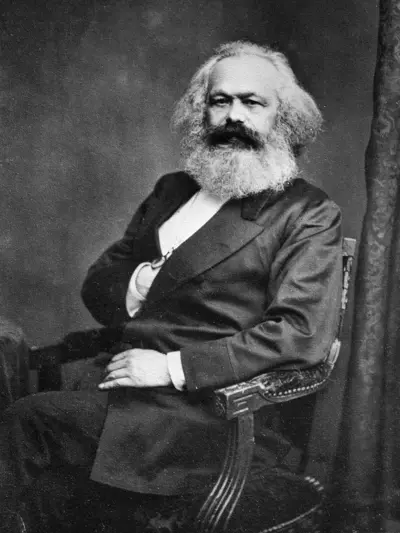
Karl Heinrich Marx was a German philosopher, economist, historian, sociologist, political theorist, journalist and socialist revolutionary. Born in Trier, Germany, Marx studied law and philosophy at university. He married Jenny von Westphalen in 1843. Due to his political publications, Marx became stateless and lived in exile with his wife and children in London for decades, where he continued to develop his thought in collaboration with German thinker Friedrich Engels and publish his writings, researching in the reading room of the British Museum. His best-known titles are the 1848 pamphlet The Communist Manifesto and the three-volume Das Kapital (1867–1883). Marx's political and philosophical thought had enormous influence on subsequent intellectual, economic and political history. His name has been used as an adjective, a noun, and a school of social theory.
