William Blake Quotes
Commerce is so far from being beneficial to arts, or to empire, that it is destructive of both, as all their history shows, for the above reason of individual merit being its great hatred. Empires flourish till they become commercial, and then they are scattered abroad to the four winds.
Blake, William. The Complete Poetry and Prose of William Blake. Edited by David V. Erdman, Anchor Books, 1988, p. 574.


1st Viscount Bolingbroke

Over 100 years later a group of Islamic Modernists and Scientists came to a similar conclusion.

At its largest, the Ottoman Turkish Empire included all of the Middle East, most of North Africa, much of Russia, and Europe right up to the walls of Vienna.


This was not always true in America but became so in the 20th century. It was true to some extent even earlier in England – see {630505}. Then it also became true in some other industrial democracies.


While generally true, Mises here again exaggerates his “proof” by selectively ignoring or being ignorant of counter-examples. The Roman Catholic Church is a classic counter-example where priests, monks, and others owned nothing as individuals, but produced some great science (eg Gregor Mendel), art (the illuminated texts of the middle ages), literature (St Thomas Aquinas, etc). The best counter example that was just evident in the last decade of Misis’ life is Communist Russia. Russian science was better than Fance and Germany and second only to the United States. The Russian ballet and orchestras were second to none. Great literature came out of the Soviet Union and the best of it complained about and attacked the Soviet system of the times. In general, Mises principle tended to be correct throughout history but not always as he dogmatically stated.

The industrial revolution was also creating an entirely new form and structure for international economics.

The Chinese Emperor Qianlong would not allow entry to Chinese ports by Western (Christian) traders {641621}. The nation was already somewhat unstable {641623}, and it might not take much to topple it.


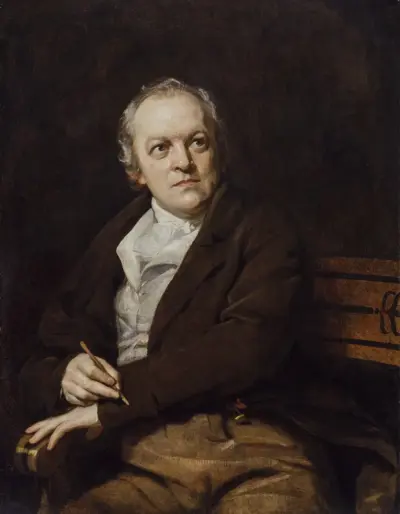
William Blake was an English poet, painter, and printmaker. Largely unrecognised during his lifetime, Blake is now considered a seminal figure in the history of the poetry and visual arts of the Romantic Age. What he called his prophetic works were said by 20th-century critic Northrop Frye to form "what is in proportion to its merits the least read body of poetry in the English language". His visual artistry led 21st-century critic Jonathan Jones to proclaim him "far and away the greatest artist Britain has ever produced". In 2002, Blake was placed at number 38 in the BBC's poll of the 100 Greatest Britons. While he lived in London his entire life, except for three years spent in Felpham, he produced a diverse and symbolically rich œuvre, which embraced the imagination as "the body of God" or "human existence itself".
