Stephen Moore Quotes
Coal is tied to steel jobs, trucking jobs, and manufacturing jobs.
Moore, Stephen. "The War on Coal is a War on America." Creators Syndicate, 17 Oct. 2017.

At the time this article was written coal was being phased out in most of the country but not as the result of any political actions. The new technologies of producing shale oil and fracking had driven down the price of natural gas and oil, making coal the most expensive fuel alternative so the market place was finally doing what the politicians would not do. Ironically, the conservative politicians from coal producing states like West Virginia and Kentucky, who would normally say that government should always defer to the marketplace, then called for government action to protect the coal industry from the marketplace.

This was the first time that the Environmental Protection Agency had vetoed a permit for a mountain top removal coal mining project that had been granted by the Army Corps of Engineers. The proposed project, Spruce 1, would have removed the entire top of a mountain. It would have created a number of jobs, but it also would have polluted a number of streams in the area and would have affected the ground water of people in the area. What made this a most difficult political decision was that the economic damage was clear as was the science showing the water damage. The people in the community were split over which was the worse alternative.

The alarm that we were running out of energy sources was first raised because the steam engine would take so much coal. Lardner, felt that there was a much larger supply than needed for steam engines.


This quotation became a slogan of the miners. Lewis did not originate it. It has been referred to as early as 1902 in the bitter coal strike of that year. Generally coal mining strikes have involved more force and military than most labor disputes. While labor representatives maintain that force does not help, mine owners have believed that force is absolutely necessary. See Richard B. Mellon’s testimony to Congress in 1937--{563576}.


As a member of the Crow Tribe living on the Montana Crow Reservation, she recieved, alomg with all other tribal members, about $225 every quarter for the royalty payments that a commercal coal mining company paid on the coar that they mined on the Crow land. The demand for coal had been steadily decreasing for over a decade since coal was the worst of the fossil fules in terms of polluting the air and emitting greenhouse gases increasing the global warming. With the Fracking technology, oil had become much less expensive as was natural gas, making coal not only the dirtiest fuel for producing electricity but one of the most expensive whereas in the past it had been the least expensive. The Montana Crow Reservation was econmically destitute, with no industry, very little agriculture, and littel else to help the local economy other than the royalty payments for coal mining. In other parts of the country otehr Indian nations were giving up economic benefits that came from enviornmentally damaging commercial activity and there was some pressure on teh Crow nation to close the reservation to coal mining. Ms. Ten Bear Reed's quotation illustrated the great dilemma that she, the Crow, other Indian tribes and general citizens all over the country. For decades many areas of the country had been in economic recession, and poverty was endemic. The royalties from coal mining, oil drilling, pipeline right of way and other commecial activities that did or potentially threatened the enviornment was in many cases the only cash families and tribes recieved or it was a large proportion of their income. The moral dilemma was profound when there were chilren to feed and care for. it was much harder for the poor to be environmentally conscious than for people who were economivally better off.
This quotation on the surface appears to be a clear summary of the scientifically measured negative aspects to coal. However, it was an extremely bitter political quotation. The reason was that West Virginia and the other parts of Appalachia depend on coal for employment—jobs for the residents in a poverty-stricken area where there are few other potential sources for employment. Coal is also a key economic component of the economy in Wyoming. These states regard the reduction of coal as an energy source as one of the most serious political threats to their states and the treat it accordingly. West Virginia has Democratic Senators and congressmen from Appalachia. Wyoming has Republicans. Both exert enormous pressure on their Congressional Party leadership and the White House. With the country and Congress split at the time, Republicans had control of the House, and Democrats, the Senate and the Presidency—by very narrow margins so the leaderships cannot offend anyone in Congress. The result is that there was almost total silence about the huge coal pollution problem, and even in the second decade of the 21st century, where shale natural Gas was extractable in sufficient quantities to totally replace Coal as a fuel source, few in Congress or the administration ever even spoke of adopting a national policy to this effect, much less passed any legislation. During this period many Americans sickened and died as a result of coal every year with no end in sight.


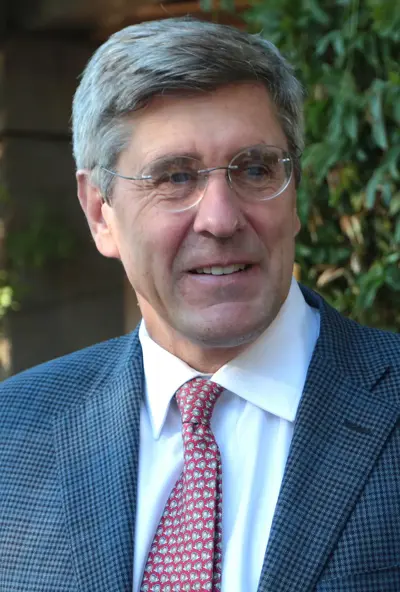
Stephen "Steve" Moore is an American writer and television commentator on economic issues. He co-founded and served as president of the Club for Growth from 1999 to 2004. Moore is a former member of the Wall Street Journal editorial board. He worked at the Heritage Foundation during the period from 1983 to 1987 and again since 2014. Moore advised Herman Cain's 2012 presidential campaign and Donald Trump's 2016 presidential campaign.
