A. P. Herbert Quotes
Citizens who take it upon themselves to do unusual actions which attract the attention of the police should be careful to bring these actions into one of the recognized categories of crimes and offences, for it is intolerable that the police should be put to the pains of inventing reasons for finding them undesirable.
Alan Patrick Herbert, 1890-1971, British Writer & Member of Parliament, Uncommon Law, 1935
Sourced by: Eigen's Political and Historical Quotations


This is the most formalized and sophisticated compendium of laws of the so-called “barbaric peoples” of Europe. The compilation was in many ways a documentation of the traditional laws of the Visigoths that had evolved over hundreds of years. In this case, the principle was an old ancient Roman principle—see {617205}


CREEP in the Nixon Campaign. He was himself a convicted Watergate conspirator


Samuel Langhorne Clemens, 1835-1910
Actually a few minor characters were prosecuted for financial crimes committed during that period but none were prosecuted whose behavior caused or accelerated the meltdown, and no bank officers were prosecuted despite the FBI reporting that hundreds of thousands of Mortgage Foreclosure involved perjury by bank officers in a pattern that was used by most of the large major banks. The Obama administration was in the dilemma of either choosing one or two bank officers of whom to make an example or if all those who had committed serious crimes were prosecutors, it would involve thousands of the officers of almost every major bank and tens of thousands of officials and mortgage related firms. These were among the wealthiest and most influential people in the country, and there would be few left to build the American Banking System back up when that was one of our most important national priorities. They were also amongst the largest political contributors to both political parties. So the government bailed the bankers out financially, allowed them to maintain million dollar of more salaries and bonuses, and gave the entire batch of people who broke the law a de facto immunity from criminal prosecution. A further complicating factor was that many of the most egregious, greedy, and publicly harmful were not illegal as a result of much change in the law as a part of financial deregulation or were new schemes that the financial industry had successfully lobbied to prevent regulation as with Derivatives.


Earlier, a virtually all white police force in nearby 67% Black Ferguson, had shot an unarmed black young man who was 20 feet away with his hands up, 7 times killing him and then leaving the body uncovered on the street for over 4 hours. Many people of all races began to peacefully demonstrate in Ferguson and were met with military assault weapons pointed at them and military armored vehicles, with the police illegally (as later determined by the courts) were interfering with the right to protest. The demonstrations turned to riots and there was looting and arson of business establishments. The demonstrations started to spread to nearby St. Louis and other cities as the news spread. While the Ferguson officials had behaved so badly and stupidly, the St. Louis mayor exhibited democratic leadership that was an example for others. Slay was then a 4 term mayor, being reelected more than any other mayor in St. Louis history, and was one of the outstanding politicians in America.


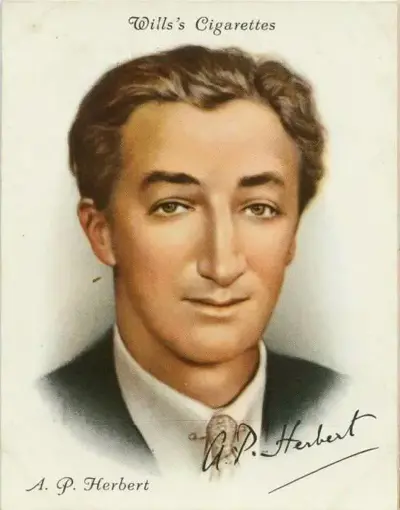
Sir Alan Patrick Herbert CH, usually known as A. P. Herbert or simply A. P. H., was an English humorist, novelist, playwright and law reform activist, and an Independent Member of Parliament for Oxford University from 1935 until 1950, when university constituencies were abolished. Born in Ashtead, Surrey, Herbert attended Winchester College and New College, Oxford, graduating with a starred first in Jurisprudence in 1914. He joined the Royal Naval Volunteer Reserve as an ordinary seaman in World War I, later serving as an officer with the Royal Naval Division. He fought in Gallipoli and on the Western Front, becoming battalion adjutant in 1917, before injury excluded him from the front line. After the war, he published The Secret Battle and joined the staff of Punch in 1924. He also wrote librettos for musicals. Elected as Independent MP for Oxford University in the 1935 general election, Herbert campaigned for private member's rights, piloted the Matrimonial Causes Act 1937 through Parliament, opposed the Entertainments Duty, and campaigned against the Oxford Group. He joined the River Emergency Service in 1938 and served in World War II as a petty officer in the Royal Naval Auxiliary Patrol. He captained his river boat, the Water Gipsy, on the River Thames. In 1943, he joined a parliamentary commission to investigate the future of the Dominion of Newfoundland.
