Qianlong Emperor Quotes
Christianity is the religion if the West, and their Celestial Dynasty has its own beliefs bestowed by our sacred and wise monarchs, which have enabled our 400 million subjects to be led in an orderly fashion. Our people must not be confused by heresy …. The Chinese and the foreigners must be strictly separated.
Qianlong, 1711-1799, Fifth emperor of the Chinese Manchu Qing Dynasty, Letter to English King George III rejecting the king’s proposal to open up Chinese ports to trade
Sourced by: Eigen's Political and Historical Quotations

The Emperor had refused to allow trade between China and the Western “Christians” See {641621}. The English diplomats implied to the Emperor that the ships would trade with costal Chinese despite his edicts. He threatened to use force to prevent contact. His Empire, however, was not strong enough militarily to keep the English and other Christians away.

The Chinese Emperor Qianlong would not allow entry to Chinese ports by Western (Christian) traders {641621}. The nation was already somewhat unstable {641623}, and it might not take much to topple it.

The Founding Fathers represented a wide range of religious beliefs from orthodox Christians to Agnostics and Atheists. Most considered themselves Christian, but having studied the terrible results of European religious dissention in Government were careful to keep government and religion separate. In New York City, for example, when George Washington was first inaugurated as President, there was no religious ceremony in the government buildings. However, the President and all the Congress then went to Trinity Church close by and had a religious service. The earliest example of separation of church and state was a separation of official religion—not an elimination of religion.

Some other Republican governors thought that Fordice had misspoken and offered him a chance to correct or modify his statement. He declined.


A conservative Calvinist weekly periodical. At the time the term “Turk” referred to all Muslims as the Turkish Ottoman Empire controlled most Muslim countries.


Those who claim that the founding fathers contemplated religion as a critical component of government often point to this article of the South Carolina Constitution. However, they ignore the almost simultaneous passage of the New York constitution as in {612166}. When the framers of the Constitution met in 1787 in Philadelphia the separation of church and state issue was not really resolved and awaited the Bill of Rights where the separatists won out.

It is thought that the eating of the host in the Christian Communion was the origin of the rumor which permeated similar to a modern urban legend. If the Missionaries ate bodies to celebrate their Christ, the peasants thought, they must have some bodies to eat. And since poor children disappeared frequently do to accident or abduction for work, it was an easy jump pf “logic” to assume that the missionaries had taken them to eat. There was a period in the Middle Ages in Europe where Christians thought that Jews kidnapped Christian children and ate them at religious ceremonies.

Objectors to the Separation of Church and State Doctrine point to this quotation to justify giving preferences to Christians in majority Christian societies and presumably to prefer Muslims in Islamic nations. Most of the Founding Fathers and most of the general population were on the opposite side of this issue. Hence the First Amendment was one of the conditions for ratification. There has always been a large minority who believe that America was founded by people who were mostly Christian (Protestant) and there is nothing wrong with having America be a Christian nation and preferring Christians for key government positions.


Buddhists believe in reincarnation and by donating money they are attempting to secure a higher (and avoid a lower) station for themselves in the next life.

Samuel Langhorne Clemens, 1835-1910


The Vatican & the Chinese Communist Government had been at odds for years with much of the Chinese church going underground. Fr. Jin had been jailed for a decade. Then the government allowed him and the Catholic Church and operate openly, but there were still Vatican conflicts over numerous issues including the right of the Government to approve senior appointments of church officials—a privilege the church claimed exclusively. The Vatican ordered Jin not to cooperate and especially not to reopen the national theological seminary which the government had ordered closed. There had been no training for Chinese priests and Jin wanted to reopen the national theological seminary but the Vatican refused cooperation waiting for the government to capitulate to the Vatican’s various demands. Fr. Jin defied the Vatican & reopened the seminary. Without officially admitting their failed tactics, the Vatican let the discipline issue against Jin drop & the national theological seminary thrived.

The phrase ‘This would be the best of all possible worlds, if there were no religion at all!!!’ is often quoted to imply that Adams was opposed to religion. This is a classic use of using quotations out of context for if one reads the entire quotation, Adams is stating that without religion the world would not be a particularly fit place. Some religionists then use the entire quotation to argue that Adams was a religious, Christian man who saw America as a Christian nation. That too is out of the context of the totality of his views—see {592753}.


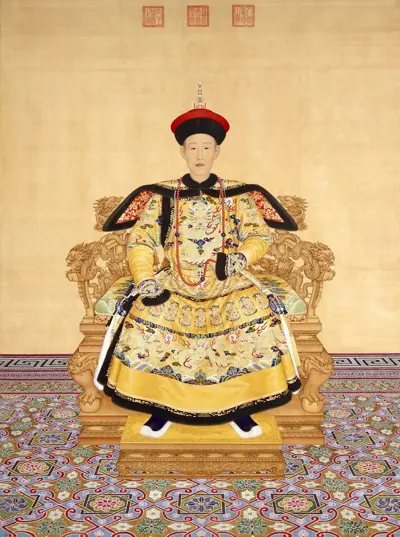
- Born: September 25, 1711
- Died: February 7, 1799
- Nationality: Chinese
- Profession: Emperor
The Qianlong Emperor was the fifth Emperor of the Qing dynasty, and the fourth Qing emperor to rule over China proper, reigned from 1735 to 1796. Born Hongli, the fourth son of the Yongzheng Emperor, he reigned officially from 11 October 1735 to 8 February 1796. In 1796, he abdicated in favour of his son, the Jiaqing Emperor—a filial act in order not to reign longer than his grandfather, the Kangxi Emperor, who ruled for 61 years. Despite his retirement, however, he retained ultimate power as the Retired Emperor until his death in 1799. He thus was one of the longest-reigning rulers in the history of the world, and dying at the age of 87, one of the longest-lived. As a capable and cultured ruler inheriting a thriving empire, during his long reign the Qing Empire reached its most splendid and prosperous era, boasting a large population and economy. As a military leader, he led military campaigns expanding the dynastic territory to the largest extent by conquering and sometimes destroying Central Asian kingdoms.
