Arthur Levitt Quotes
But when that information travels only to a privileged few, when it is used to profit at the expense of the investing public, when that information comes by way of favored access rather than by acumen, insight or diligence, we must ask, 'Whose interest is really being served?'.
Levitt, Arthur. "Quality Information: The Lifeblood of Our Markets." U.S. Securities and Exchange Commission, 18 Oct. 1999.


The States sold bonds to finance the Revolutionary War. Some states had better prospects for redeeming their bonds than others. Georgia, South Carolina and North Carolina in particular had poorer prospects than most and their bonds were selling at about 25 cents on the dollar. Alexander Hamilton, then the Secretary of the Treasury, wanted the new Federal government to assume the state’s war debt and pay off the bonds. He made his proposal for how he would accomplish this on January 14, 1790. He delivered his report and proposal to Congress “Report on the Public Credit”. As soon as Hamilton’s proposal was read in Congress, sophisticated speculators set off for the Southern States to buy up as many bonds as they could before the owners found out that a Federal bail-out was under serious consideration. They could easily double, triple or even quadruple their money. To Jackson this was gross immorality. Other representatives had a different point of view. See {619928} & {619939}.


This was a best seller when published in China. It is surprising to many that the Chinese censors even allowed it to be published.

Despite this, he recommended that the average person should participate in some limited ways.

Trump himself was known for being quite greedy and this admission was made before the Wall Street firms had been shown to be as greedy as they were during the aftermath of the 2008 economic meltdown recession when Wall Street Executives had their entire industry bailed out by the average taxpayer. Then they demanded their multi-million dollar bonuses while a large proportion of the people whose taxes bailed them out, were put out of work themselves by the greed, risk and profligacy of Wall Street.

While not every person in the stock market was dishonest, a large number were, and the system itself was inherently unfair and disadvantaged the average investor. Despite the many reforms attempted over the years, as the 2008 meltdown proved, the same problem was still with us. Capone was essentially right then and even today.


The bill went down to a narrow defeat, but the Republican leadership of the House held the vote open for a record setting 3 hours, until they could persuade enough members to reverse their vote. After the 3 hours, the bill passed by one vote. The House Ethics Committee did not see that as sufficient reason to start an ethics investigation.
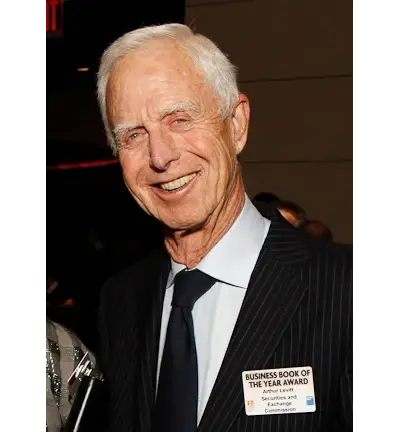
Arthur Levitt Jr. is the former Chairman of the United States Securities and Exchange Commission (SEC). He served from 1993 to 2001 as the twenty-fifth and longest-serving chairman of the commission. Widely hailed as a champion of the individual investor, he has been criticized for not pushing for tougher accounting rules. Since May 2001 he has been employed as a senior adviser at the Carlyle Group. Levitt previously served as a policy advisor to Goldman Sachs and is a Director of Bloomberg LP, parent of Bloomberg News.
