Peter Bergen Quotes
Because 9/11 was carried out by 19 foreign-born Arab hijackers, many assume that all terrorists who attack the West are foreigners.
Bergen, Peter. United States of Jihad: Investigating America's Homegrown Terrorists. Crown Publishers, 2016.

36 days later, September 11, he did strike, and at the World Trade Center. The memo was kept secret by the Bush administration until public pressure as a result of the 9-11 Commission hearings forced the declassification and release. At that point it became clear that there was no reason that the memo could not have been released much earlier except that it was embarrassing.

He was making the argument that Saudi Arabia has been the largest supporter of Islamic extremism and terrorism. While the U. S. Government does not agree, that are many Americans who hold this same view and have been arguing it even before.


This quotation illustrates the dissentions that exist between the various Islamic terrorist organizations. The Secretary General of Hezbollah herein castigates the rival and more religiously fundamentalist Al Qaeda for killing innocent Muslims. Not only do neither mind killing innocent people who are not Muslims, but Hezbollah indiscriminately fires rockets into Israeli populated areas and has killed innocent Muslims, Christians and Jews. Further, Hezbollah will force Muslim citizens of Lebanon to store arms and allow rocked firing from their properties and institutions like schools, mosques, and hospitals, knowing perfectly well that they minute they do this, under the Geneva conventions, those homes or institutions become a legal target for retaliatory attacks, artillery, air strikes or ground forces and that innocent Muslim civilians would be killed. The levels of terrorist subtlety is difficult for Westerners to comprehend.

This quotation was used by many who opposed foreign aid to Egypt. At the time, Egypt was the second largest recipient of American foreign aid and yet there were leading Egyptians who held views like this. Advocates of aid to Egypt argued that it was in large part the American aid that was preventing radicals like Sabahi from controlling Egypt.

Both Islamic terrorists and anti-terrorist Muslims believe that they are following the world of God. Which group is the “hijacker” can be argued either way which is why the “hijack” notion turns out not to be very useful, However, despite intense pockets and even countries where the terrorist view of Islam is in the majority, the majority of Muslims in the world reject the terrorist interpretation of Islam. The difficulty lies on supporting the anti-terrorist Muslims and fighting the Islamic Terrorists without offending the former by conflating all Muslims together.

Bush claimed he did not remember the conversation. His incoming National Security Advisor, Condoleezza Rice, was also briefed about bin Laden by the Clinton anti-terrorism director, Richard Clarke. The Bush Administration ignored the warnings until bin Laden struck on 9-11


Slogans taken from posters listing 10 people targeted by Muslim extremists. Most were people who had said or published material that some fundamentalist Muslims had decided were offensive to Islam. One was Charlie Hebdo, the French Publisher who Islamic terrorists murdered later. Note the Americanisms that the terrorist propagandists adopted. The Wanted Dead or Alive was taken from the posters of the American West of the 19th century. The "Yes we can" was lifted from the Barack Obama 2008 campaign slogan. The "Bullet A Day Keeps the Infidel Away" is a takeoff on the American saying "An apple a day keeps the Doctor away." One of the reasons for these Americanisms was that the founding editor was Samir Khan, self-described American traitor.


She had been covering Muslim nations and leaders for a long time and saw the relationship between the contemporary domination of Islamic fundamentalism and terrorism long before most.
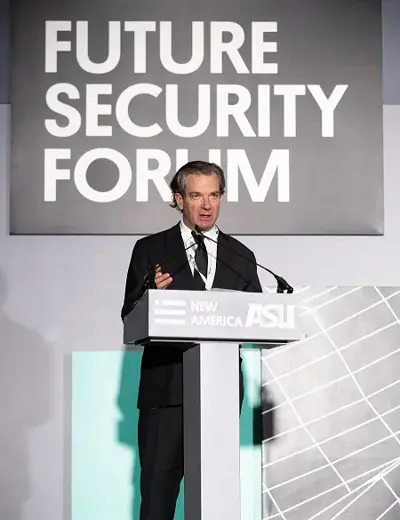
Peter Bergen is an American journalist, author, and producer who serves as CNN's national security analyst, New America's vice president, and as a professor of practice at Arizona State University. He produced the first television interview with Osama bin Laden in 1997. The interview, which aired on CNN, was the first time that bin Laden was interviewed by Western media.
