Mohammad Javad Zarif Quotes
Who was behind the attack on America of 2011? 15 of the 18 terrorists were from Saudi Arabia and the ideology that they followed was from Saudi Arabia …. Saudi Arabia has supported the Taliban and Al Qaeda before the United States was attacked. Most of their funds came from Saudi Arabian individuals. But more important, the ideology that they followed came from Saudi Arabia.Who was behind the attack on America of 2011? 15 of the 18 terrorists were from Saudi Arabia and the ideology that they followed was from Saudi Arabia …. Saudi Arabia has supported the Taliban and Al Qaeda before the United States was attacked. Most of their funds came from Saudi Arabian individuals. But more important, the ideology that they followed came from Saudi Arabia.
He was making the argument that Saudi Arabia has been the largest supporter of Islamic extremism and terrorism. While the U. S. Government does not agree, that are many Americans who hold this same view and have been arguing it even before.
Mohammad Javad Zarif, Interview, The Charlie Rose Show, July 19, 2017
Sourced by: Eigen's Political and Historical Quotations


The Wahabi Islamic sect has been a major force in spreading Muslim fundamentalism and terrorism throughout the world. It’s funding has come primarily from Saudi Arabia and the royal family. See John McCain {606851}


Duran has been the subject of major criticism and attack by many who regard the term as too prejudicial and inflammatory, that there is an automatic association in the term of all Islam and Fascism. While Duran’s position is that the term only applies to extremists who embrace values and actions that were consonant with Fascism, there are other Islamic critics who believe that basic Islam is Fascistic per se and the term should be applied to almost everything Islamic.
Some think that origination credit should go to Malise Ruthven who used the word in an article published in The Independent of September 8, 1990

She had been covering Muslim nations and leaders for a long time and saw the relationship between the contemporary domination of Islamic fundamentalism and terrorism long before most.

Son of Reverend Billy Graham. While parts of the Koran do preach violence, parts of the Old Testament also do, as do parts of the New Testament such as the Book of Revelations.

Both Islamic terrorists and anti-terrorist Muslims believe that they are following the world of God. Which group is the “hijacker” can be argued either way which is why the “hijack” notion turns out not to be very useful, However, despite intense pockets and even countries where the terrorist view of Islam is in the majority, the majority of Muslims in the world reject the terrorist interpretation of Islam. The difficulty lies on supporting the anti-terrorist Muslims and fighting the Islamic Terrorists without offending the former by conflating all Muslims together.

He was comparing the Muslim Brotherhood and ISIS. H was trying to eradicate both organizations. Most Western leaders saw the Muslim Brotherhood as a less dangerous and less virulent organization than ISUS, HAMAS and other more overt terrorist organizations. Siri however has perspective of owe 50 years of history with the Muslim Brotherhood, and although they have got through periods of claimed political participation and not terrorism, Sisi and other Egyptians observe that all of these more virulent terrorist troops share the same ideology and end goals as the Muslem Brotherhood, and all these terrorist groups have been outgrowths of the Muslim Brotherhood. H argues that the Brotherhood must be wiped out else there will be more and more terorist groups to replace those that we might destroy.


Slogans taken from posters listing 10 people targeted by Muslim extremists. Most were people who had said or published material that some fundamentalist Muslims had decided were offensive to Islam. One was Charlie Hebdo, the French Publisher who Islamic terrorists murdered later. Note the Americanisms that the terrorist propagandists adopted. The Wanted Dead or Alive was taken from the posters of the American West of the 19th century. The "Yes we can" was lifted from the Barack Obama 2008 campaign slogan. The "Bullet A Day Keeps the Infidel Away" is a takeoff on the American saying "An apple a day keeps the Doctor away." One of the reasons for these Americanisms was that the founding editor was Samir Khan, self-described American traitor.

This quotation illustrates the dissentions that exist between the various Islamic terrorist organizations. The Secretary General of Hezbollah herein castigates the rival and more religiously fundamentalist Al Qaeda for killing innocent Muslims. Not only do neither mind killing innocent people who are not Muslims, but Hezbollah indiscriminately fires rockets into Israeli populated areas and has killed innocent Muslims, Christians and Jews. Further, Hezbollah will force Muslim citizens of Lebanon to store arms and allow rocked firing from their properties and institutions like schools, mosques, and hospitals, knowing perfectly well that they minute they do this, under the Geneva conventions, those homes or institutions become a legal target for retaliatory attacks, artillery, air strikes or ground forces and that innocent Muslim civilians would be killed. The levels of terrorist subtlety is difficult for Westerners to comprehend.


Most Americans and Europeans and their governments feel that Muslim leaders and organizations have not done very much in terms of “drawing the line” and publicly condemning terrorism. However many of the critics did not understand the intimidation that exists in most Islamic communities where the fascist fundamentalists target any Muslim public critics as heretics and apostates themselves. Many have been killed or injured in assassination attempts.
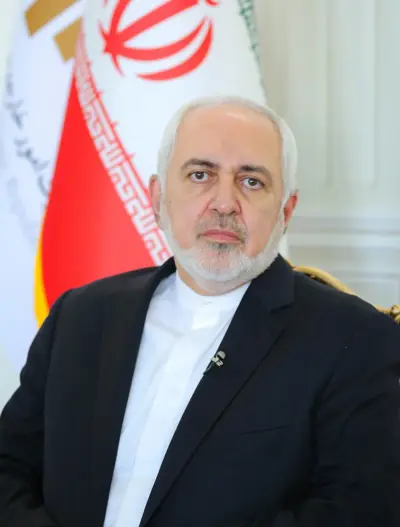
Mohammad Javad Zarif is an Iranian career diplomat and academic. He has been foreign minister of Iran since 2013. During his tenure as foreign minister, he led the Iranian negotiation with P5+1 countries which produced the Joint Comprehensive Plan of Action on 14 July 2015, lifting the economic sanctions against Iran on 16 January 2016. On 25 February 2019, Zarif resigned from his post as foreign minister. His resignation was rejected by President Hassan Rouhani and he continues as foreign minister.
