Foreign Policy Quotes
Bad neighbors will keep cartographers busy well into the next century.
Foreign Policy Commentary, Fall 1999
Sourced by: Eigen's Political and Historical Quotations


She and her husband, like many of the "America Firsters", believed that Hitler should be allowed to overrun Europe and Russia.


This was the 14th part of the Japanese reply to a previously made American peace proposal. The Japanese policy was to unite all of Asia into a co-prosperity sphere controlled by Japan where Japan would militarily conquer those Asian countries which did not “voluntarily” want to join. The Japanese were in the process of conquering China and the United States and Britain had embargoed oil and other material to Japan trying to pressure them to withdraw their troops from China and cease Japanese conquest by force. Japan believed that it was their right to conquer and control Asia and it was beneficial to the region, and that the U. S. and Britain had no right to curtail the expansion that Japan required to assure raw materials and other necessities. At the very time that these negotiations were on going, the Japanese fleet was sailing for the sneak attack on Pearl Harbor. The attack took place the very day this part of the Japanese reply was received.


At the time, the major European countries were in a competitive scramble for colonies in Africa—so much so that there were very few independent territories left. The maps and borders of Africa were really decided by the Europeans.

The Scientific Project that developed the Atomic Bomb. He was a strong advocate for disarmament and that was being debated at the United Nations. He was critical of Bernard Baruch’s tactics but it soon was clear to almost all that the Russians were not interested in a serious UN supervised disarmament. Oppenheimer was profoundly disappointed when it was clear that disarmament was being blocked by the Russians and their veto. After that he didn’t trust the Russians, and concentrated on trying have US policies that would not goad the Russians into an arms race. This quotation is particularly important because in an effort to discredit his views on nuclear policy some politicians accused him of being a security risk with the innuendo that he was a communist and even a Russian agent.


The report was from Heinrich von Tschirschky, the German ambassador to Austria-Hungary. He recommended that Germany persuade Austria-Hungary to not attack Serbia, not realizing the German leaders had already planned a war with Russia and saw the issues between the Austro-Hungarian Empire and Serbia was a good excuse to implement their war plans (see {642092}).

Theis was the phrase he used to describe the collapse of the Soviet Union. This and other statements he made about the breakup of the Russian empire, together with his actons reagading foreign affairs, led many Western observers to think that Putin was trying to build up Russia to be amajor World Power as it was relatively recently. This annual address to the Duma has the importance of the United States' President with the State of the Nation Address. Every phrase and sentence is very carefully crafted. Also see Quotation 644184 under Related Quotes foir a more explicit statement,


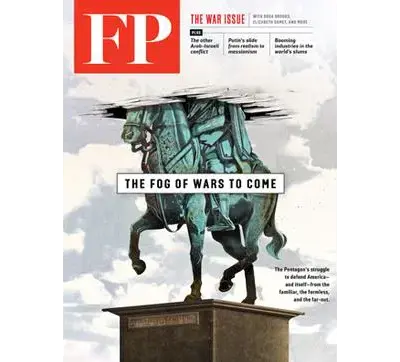
Foreign Policy is an American news publication, founded in 1970 and focused on global affairs, current events, and domestic and international policy. It produces content daily on its website, and in six print issues annually.
