Tacitus Quotes
Augustus gradually increased his powers, taking over those of the senate, the executives and the laws. The aristocracy received wealth and position in proportion to their willingness to accept slavery. The state had been transformed, and the old Roman character gone for ever. Equality among citizens was completely abandoned. All now waited on the imperial command.
Tacitus, Cornelius. The Annals of Tacitus. Translated by Alfred John Church and William Jackson Brodribb, Macmillan and Co., 1876, pp. 2-3.


Fremont and some of the Radical Republicans wanted Lincoln immediately to declare the slaves of the rebelling states free. As a major general in charge of an area, he wrote a military order emancipating all the slaves in his jurisdiction. President Lincoln countermanded the order as soon as he found out. He wanted Fremont to only free the slaves whose owners were actively working against the union. Lincoln needed to hold the border states like Maryland in the Union and was working on a plan whereby slave owners who were loyal to the Union would be economically compensated when their slaves were freed. If loyal slaveholders in Fremont’s area would lose their slaves with no compensation, Lincoln feared that the otherwise loyal border states would be driven to the confederacy thus shifting the balance of power. Lincoln had his own plan for emancipation and would not allow Fremont to alter that. As a result of this speech, the Radical Republicans nominated Fremont to run against Lincoln. For a few weeks he looked like he would run, but then he and Lincoln made a deal. Lincoln fired Montgomery Blair, Fremont’s arch enemy, from the cabinet, and Fremont withdrew from the election.


FDR was a marvelous judge of men and their character. De Gaulle could not separate himself from France and pushed the French Republic towards one man rule (himself) as much as anyone since Napoleon Bonaparte.


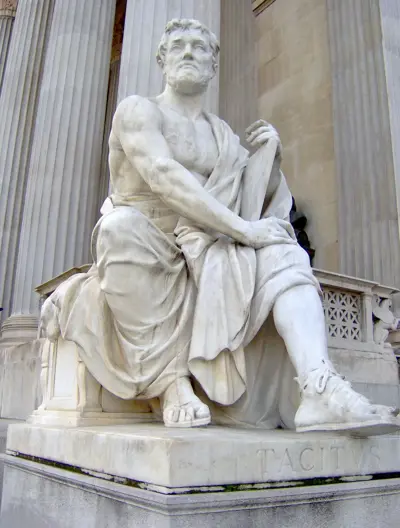
Publius (or Gaius) Cornelius Tacitus (AD 56 – c. 120) was a Roman historian and politician. Tacitus is widely regarded as one of the greatest Roman historians by modern scholars. He lived in what has been called the Silver Age of Latin literature, and has a reputation for the brevity and compactness of his Latin prose, as well as for his penetrating insights into the psychology of power politics.
