William Pitt the Younger Quotes
As the Laws now stand, an old Officer, a Man who has often ventured his Life, and often spilt his Blood, in the Service of his Country, may be dismissed, and reduced, perhaps, to a starving Condition, at the arbitrary Will and Pleasure, perhaps at the Whim of a favourite Minister; so that by the present Establishment of our Army, the Reward of a Soldier seems not to depend upon the Services done to his Country, but upon the Services he does to those who happen to be the favourite Ministers at the Time
William Pitt, 1708-1778, 1st Earl of Chatham, British Prime Minister, Secretary of State, Lord Privy Seal & leader of the House of Commons, Speech, House of Commons, February 4, 1738
Sourced by: Eigen's Political and Historical Quotations


There was no provision then for wounded and elderly soldiers. Madison’s suggestion was the beginning of the idea of The Veterans’ Administration which it would evolve into many years later.

Veterans of WWI had been authorized a bonus by Congress, and had been issued certificates, but Congress had not appropriated the money to redeem the certificates. Veterans of World War I formed a “Bonus Army,” some twenty thousand unemployed veterans and a like number of family members arrived in Washington DC with their hurting families and sett up a shantytown across the river from Capitol Hill. They demanded of Congress their bonus pay. Instead President Hoover castigated them and authorized the U. S. Army to disperse the veterans. General Douglas MacArthur commanded the troops and in one of the great disgraces of the United States, he used excessive force, MacArthur attacked women and children with infantry, cavalry and tanks. Governor Bartlett was in Washington at the time and became an eye witness in an era where there was no television.


Commenting on the hostility which greeted some returning Vietnam veterans:


There is a , romantic American myth about the Militiamen in Colonial and Revolutionary America—the citizen soldiers who would leave their farms and rise to the military necessity of the day. However, not only were the militia very hard to muster to duty, but most actually didn’t own or have experience with firearms, and the prevailing opinion of knowledgeable military leaders from George Washington on down was that the militia were not very good soldiers. See {613015}, {613016}, {613022}, {613027}, {621987}, {621988}, {613030}, {613033}, & {613056}.

Negotiations regarding the exchange of prisoners and property. This was his view of his supposed obligation to return Negro slaves who had escaped and gone to the British during the war. The treaty of peace specified that all “property” including slaves, taken by, the British be returned to the Americans. But he and other officers did not always do so as they thought they had higher moral obligations. See {621936} for example.

General Washington and his officers were constantly trying to get around the Southern bloc in the Continental Congress. South Carolina was willing because, perhaps more so than any other region of the country the South Carolina civilian population were suffering from the British military initiatives. See related quotes.

England, and most other countries of Europe, had put people who could not pay their debts in prison. When our founding fathers formed the constitution, they too saw debtors’ prison as an acceptable concept. 11 years earlier Congress had outlawed Federal Debtors’ Prisons. However many states and local governments then still had them. Smith wanted them abolished completely. What is fascinating about this quotation is that although the head of a religion, Smith was not advocating the kinds of personal lifestyle issues of his church the way modern religious leaders do, but was concerned with the much larger issues of expansionism, corruption of the courts and judiciary, and land distribution. He was a classic reform candidate in that sense. Smith had written to most of the then likely Presidential candidates of both major parties asking for their position on the Mormons who were facing persecution wherever they went. None of the politicians would make any satisfactory commitments. Smith took Direct Action and became the only major religious official to have run for the Presidency of the United States until Pat Robertson tried and failed in 2000. Smith’s assassination shortly thereafter cut his run for the Presidency short before it made much headway and politically he had no chance to affect the race.


Beaumarchais served the French King Louis XVI as a spy and advisor on foreign affairs. He was instrumental in influencing the French King and his government to tilt in favor of the American Revolutionaries.

The Centograph is a war memorial monument in London. On Remembrance Day, a British Patriotic Holiday, veterans march past the Centograph. The quotation is text uttered by one of her characters.


The George W. Bush Administration had gone to war against Iraq for reasons that turned out not to be true, and then after a military victory with few casualties, botched the occupation of the country and a vicious insurgency developed bogging down the nation in its longest war in history. The major burden fell on the armed forces and their families. The hearings were in part examining the Bush Administration policies.
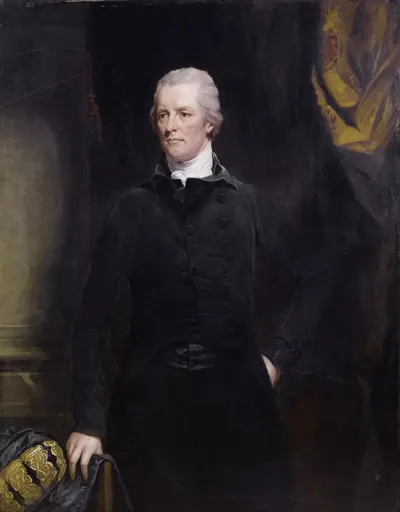
William Pitt the Younger was a prominent British Tory statesman of the late eighteenth and early nineteenth centuries. He became the youngest prime minister of Great Britain in 1783 at the age of 24 and the first prime minister of the United Kingdom of Great Britain and Ireland as of January 1801. He left office in March 1801, but served as prime minister again from 1804 until his death in 1806. He was also Chancellor of the Exchequer for all of his time as prime minister. He is known as "the Younger" to distinguish him from his father, William Pitt, 1st Earl of Chatham, who is customarily referred to as "William Pitt the Elder" (or less commonly, simply "Chatham") and had previously served as prime minister.
