Mohamed ElBaradei Quotes
As much as we Egyptians treasure our military, acting alone it cannot provide the legitimacy to lay the foundations for democracy.
ElBaradei, Mohamed. "Egypt's Democratic Mirage." The New York Times, The New York Times Company, 2012.

Referring to the use of Federal troops under General Phil Sheridan to resolve a Louisiana election dispute:


A major problem of new and emerging democracies is that many people believe that majority rule per se is democracy. In Egypt for example, Morsi and his Muslim Brotherhood won the election. They then assumed that they had the right to do anything including exempting the government from judicial review or deciding the role of women in society or denying freedom of religion to non-Muslim citizens. Democracy is not a serial autocracy with each new autocrat being selected by a free and fair election.

There is frequently a disagreement between the military and civilian leaders just as there are disagreements among most political personnel. Hawks, and people who have had experience in the military tend to think that military advice on military matters should be determinative with the President and Congress. Others tend to believe that military advice should be considered, but if it were always adhered to, there would be no point in having civilian control over the military. See {639667} for an example of when military leadership advice prevailed and it was a mistake.

The only soldier ever so honored


Essentially, the key value is civilian control of the military. For centuries in human history the civil leader has been the strongest military leader or the most influential church leader. The notion of subservience of the military to the elected civilian government is crucial and where there are other traditional roles of the military such as policing government, eliminating corruption, enforcing the Constitution and the like, the democracy exists only to the extent that the military leaders will allow it to if they have the power to control things.

There is a certain redundancy in that “Fenian” means “Party.”

Bartolo was the most famous legal expert of his day and for many years thereafter as he died at the age of 44—the height of his career. In Italy, Spain and other nations of Europe there were statutes passed that said if there was no precedent in Roman Law, the writings of Bartolo should dictate the law.

Webb was opposing the all volunteer army which became a reality despite his and others objections.


65 years later, this would become a major principle of conservatives, but it was a liberal President who seemed first to make this statement in a major address.

The Army and the other power centers of the country did not appreciate this idea. He was assinated in a coup 4 year later.


The Muslim Brotherhood which had been elected after the Arab Sprint deposition of President Mubarak, had then begun to institute their own religious philosophy into what was becoming a theocratic government. Rights of Christians, and other non-Muslims as well as moderate Muslims, together with women, democrats and advocates for human rights and freedom were trampled. 30 million people demonstrated in the streets and the nation was about to have a civil war when the military, under el-Sisi, deposed the Muslim Brotherhood government. When the Brotherhood took to the streets, many with weapons, there was a clash where almost 1000 Brothers were killed as were almost 100 police. The general was addressing the Egyptians and the rest of the world explaining the reason for breaking up the demonstrations.
SCAF: Supreme Council of the Armed Forces. This quotation illustrates how difficult it is to establish a real democracy in Egypt in particular and most Middle Eastern countries in general. Essentially, the General wants to be sure that there is no check or control on the military in the new dupposedly democratic system. In a democracy, there are only two elements that the people have selected and who represent them—the President and the Parliament. If neither of these can command and control the military, then the people have no control over the military which then becomes a de facto aristocracy that has a veto on everything in the country. Making the situation more difficult is the fact that in Egypt (as in many non democratic nations) the military owns and controls a very large segment of businesses throughout the economy—more than any corporation or wealthy family. The civilian control of the military—one of the most fundamental aspects of the United States and every other true democracy—will not likely be possible in Egypt in the next decade or so.
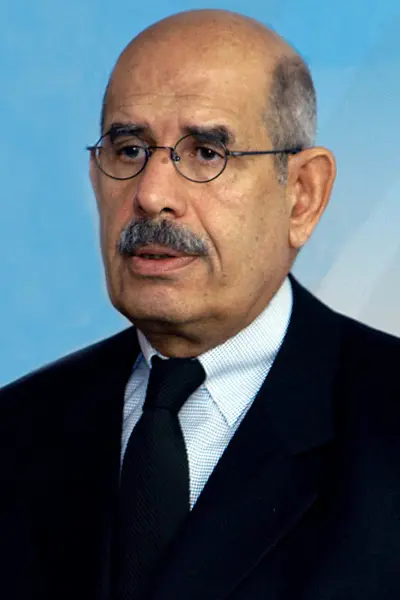
Mohamed Mustafa ElBaradei is an Egyptian law scholar and diplomat who served as Vice President of Egypt on an interim basis from 14 July 2013 until his resignation on 14 August 2013.
