Manu Quotes
As enemies do not hurt these beings, when they are sheltered by their fortresses, even so foes can not injure a king who has taken refuge in his fort. Let that fort be well supplied with weapons, money, grain and beasts of burden, with Brahmanas, with artisans, with engines, with fodder, and with water.
Manava Dharma Shastra. Preparedness and the Defense Budget was ever important in Ancient India. This text is a part of the Hindu Holy Texts. Hindus believe that Manu was a prophet whose text is revealed or inspired.
Manu, ~ 500 BC, Hindu Teacher from India, Laws of Manu
Sourced by: Eigen's Political and Historical Quotations


Manava Dharma Shastra. This text is a part of the Hindu Holy Texts. Hindus believe that Manu was a prophet whose text is revealed or inspired.
Manava Dharma Shastra. Espionage and counter espionage was called for in “good government Ancient Hindu style.” This text is a part of the Hindu Holy Texts. Hindus believe that Manu was a prophet whose text is revealed or inspired.


One difficulty of diplomacy with many Islamic leaders is that the culture produces very aggressive rhetoric and very aggressive actions like Islamic terrorism. This quotation is often cited to demonstrate that it is the Iranians that had decided that America is it’s enemy; that America is to be humbled; and that their weapons development are targeted at America. This along with the most frequent Iranian slogan, “Death to America,” for many argues for preemptive military action or maintenance of a high state of readiness. Given statements like this from the leading soldier of the theocracy, there is little doubt that Iranian nuclear weapons would be a great danger to America. Therefore when Iran complains that America did not object to the fact that other nations have the nuclear bomb, they do not take their own rhetoric into account. No other nation with possible nuclear capability has made America its major military adversity and claims as an objective to humble the United States.

If we replace the word “socialist” with “capitalist” this statement would be approved by almost every American Senior Military officer and Defense Official as well as most members of Congress. The reality was that the basic defense posture of the Soviet Union and the United States was essentially the same during the Cold War.

For a similar Ancient Greek version of this notion, See : {632265}.

The picture is a modern artist’s rendition.


Plan Orange was the code name of the united states plan for possible war with Japan. In this ironic quotation, American military planners realized five years before Pearl Harbor that surprise attack was the major vulnerability. We were surprised and had no help from our intelligence service which despite the recommendations was almost nonexistent.

Johnson was then the Assistant Secretary Of War.

The bipartisan Presidential Commission had unanimously made 41 recommendations to prevent future terrorist attacks. While the Bush Administration and Congress implemented a few many of the more critical ones were left unaddressed. The commission on its final day issued a report card giving failing grades to both the White House and the Republican-controlled Congress.


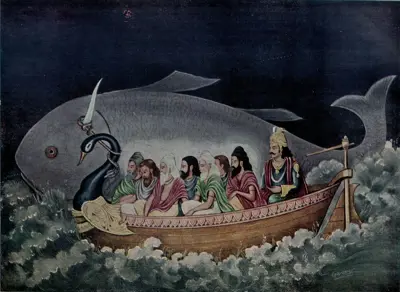
Manu (Sanskrit: मनु) is a term found with various meanings in Hinduism. In early texts, it refers to the archetypal man, or to the first man (progenitor of humanity). The Sanskrit term for 'human', मानव (IAST: mānava) means 'of Manu' or 'children of Manu'. In later texts, Manu is the title or name of fourteen mystical Kshatriya rulers of earth, or alternatively as the head of mythical dynasties that begin with each cyclic kalpa (aeon) when the universe is born anew. The title of the text Manusmriti uses this term as a prefix, but refers to the first Manu – Svayambhuva, the spiritual son of Brahma.
