Thomas Carlyle Quotes
Armed Soldier, terrible as Death, relentless as Doom; doing God's judgement on the Enemies of God. It is a phenomenon not of joyful nature; no, but of awful, to be looked at with pious terror and awe.
Carlyle, Thomas. Oliver Cromwell's Letters and Speeches: With Elucidations. Vol. 1, Chapman and Hall, 1845.

On May 26, 1887 President Grover Cleveland, himself a Union Army Civil War veteran, issued an Executive Order providing that the captured Confederate regimental flags held as trophies by the War Department be returned to the States of the regiments from which they were captured. Union veterans were outraged:. Within three weeks the president rescinded the order, caving in to pressure from the major veterans organization of the day, The Grand Army of the Republic. Many years later President Theodore Roosevelt ordered the flags returned to the former Confederate states.


This document was issued in the form of what today would be called a press release or a white paper. Altmark was the Lutheran seat of intellectuality and this document was part of a major Lutheran initiative to propagandize against the rising science of astronomy. The Catholics did the same and both religions saw astronomy as an enemy and evil. See {612384}


A massive earthquake struck Japan, destroying most of Tokyo and Yokohama. The deaths were so extensive that no official count was ever made. At the time, Japanese politics was polarized by two factions: One urged Japan to become democratic and modern like the West; the other, urged Japanese right wing militarism and expansionism. The shock of the Japanese population of such an enormous natural disaster, were seem by most Japanese as a punishment from God as Yasubumi and many other Japanese leaders stated. The reason for the punishment claimed by most was the recent adoption of Western ideas, lifestyles and particularly the trend away from traditional Japanese authoritarian government and toward Democracy. Japan then rejected democratic ideas and followed a militaristic, expansionistic, aggression leading directly to WWII.

During the American Revolution many patriot clerics argued against the monarchy by claiming that God has given Kings to the Ancient Jews—who had a type of Republic—as a punishment. Therefore monarchy is to be avoided.


Yazid ibn al-Walid ibn 'Abd al-Malik. This is an Islamic doctrine that operates to this day together with the stricture that a bad ruler must be endured and not revolted against UNLESS he does not follow his Islamic religious obligations. This is why many Islamic rulers curry favor with the clerics. As long as they do not claim he is violating the word of God, his rule is safe from revolution. However, if the clerics turn on him, he is in deep trouble. Thus Saudi Arabia endures a monarchy and the ruling family pays the Wahhabi enormous sums to avoid their religious condemnation.

He was reacting to the fact that the Supreme Court had ruled that a State could not criminalize adult, consensual, homosexual behavior.

As a slave holder himself, this was a dramatic statement. Slavery was immoral, God’s justice will not be on the white slave owners side, a slave revolt or other event could occur and change things radically. One great puzzlement of American history has been why Jefferson, who wrote so eloquently against slavery and predicted the disaster that would come. would himself keep his slaves and never free them as George Washington did. Some argue that he was so broke financially, that he could not afford to free them.
His perception that the loss of the war for the South was God’s retribution for Southern Slavery and treason was very common in the North. The young man was shocked at the difference between the educational levels of he and his Michigan comrades vis a vis their Southern counterparts. The Southern slave-centered economy didn’t provide a very good education, even for its own white citizens. 150 years after the Civil War, the South was generally behind the rest of the country in average educational.achievement.


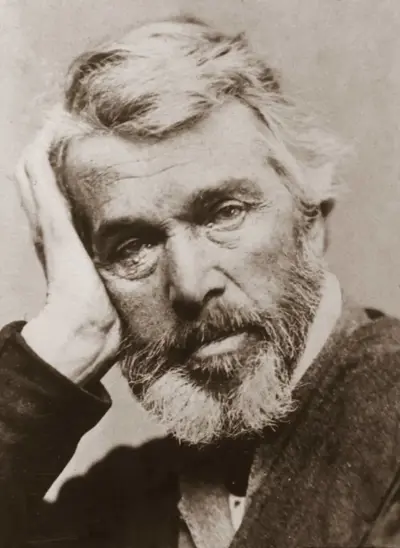
Thomas Carlyle was a Scottish historian, satirical writer, essayist, translator, philosopher, mathematician, and teacher. In his book On Heroes, Hero-Worship, and The Heroic in History (1841), he argued that the actions of the "Great Man" play a key role in history, claiming that "the history of the world is but the biography of great men". Other major works include The French Revolution: A History, 3 vols (1837) and The History of Friedrich II of Prussia, Called Frederick the Great, 6 vols (1858–65).
