Al Capp Quotes
Anyone who can walk to the welfare office can walk to work.
Al Capp, 1909-1979, Alfred Gerald Caplin, Cartoonist, View on welfare
Sourced by: Eigen's Political and Historical Quotations


Nixon’s view was very popular, except the reality of the welfare system was much more complicated than most people thought. A very large percentage of the adults on welfare were women with young children. There was no practical way for them to work unless there was some mechanism for caring for the children. Most of these women could only earn minimum wage which was not enough to cover the cost of child care. Providing child care would then cost more welfare money for this investment and politicians, even those hating the welfare system as it was, would not make this investment which would have dubious payoff. Training the women for better paying jobs and covering their child care in the process, works but the investment is very large and gives the government even more control of American life so there has never been a consensus for this. In other cases, women could get work but not having an automobile, they could not get to jobs in most of the United states. Further, requiring welfare recipients to work, collapsed when the economy was in recession. Many women just could not find jobs, and even when the government provided assistance, the state of the local economy determined whether or not workfare was practical.


This appears to be one of the first expressions of the 'workfare' concept.


He wanted to condition long term unemployment insurance payments on the recipient taking training courses or other means of improving his/her skills and becoming more employable. He was opposed on the left by those who observed that this was insurance; the working nothing from the government; the worker had paid for it when he/she was working. It was his and was not conditioned on government requirement. The right wing opposed the idea as they had always wanted the out of work people to have little or no other opportunity than to take the worst and lowest paying jobs in the society. They also pointed out that if training was to be provided, it would cost more and not less. But Gingrich and his supporters on this idea observed that there were many jobs available even with the high unemployment rate; the unemployed workers just did not have the skills to do these jobs. Train them and unemployment would go down. The investment in unemployment insurance and training would pay off many times over.


This clause is an interesting combination of liberal and conservative ideas. The former was the fact that it was the society’s obligation to provide jobs for the willing workers and welfare for the needy. At the same time, there was to be no assistance to the people who would not work—a classic conservative welfare reform.


This statement was a total reverse of his predecessor’s policy. Hoover stubbornly refused to consider any direct relief for workers on the philosophical ground that it would weaken their character, make them dependent, and provide benefits for the people who were not working so the motivation to work would be lessened. When FDR pronounced this on the radio, it dramatically reversed U. S. policy and gave many people hope that the government might do something about the depression rather than just wait out the business cycle.


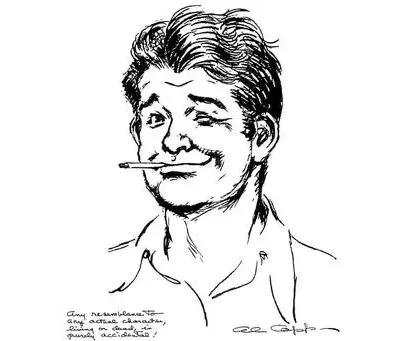
Alfred Gerald Caplin, better known as Al Capp, was an American cartoonist and humorist best known for the satirical comic strip Li'l Abner, which he created in 1934 and continued writing and (with help from assistants) drawing until 1977. He also wrote the comic strips Abbie an' Slats (in the years 1937–45) and Long Sam (1954). He won the National Cartoonists Society's Reuben Award in 1947 for Cartoonist of the Year, and their 1979 Elzie Segar Award, posthumously for his "unique and outstanding contribution to the profession of cartooning". Comic strips dealt with urban experiences in the northern states of the USA until the year Capp introduced "Li'l Abner". Although Capp was from Connecticut, he spent 43 years teaching the world about Dogpatch, reaching an estimated 60 million readers in more than 900 American newspapers and 100 more papers in 28 countries internationally. M. Thomas Inge says Capp made a large personal fortune through the strip and "had a profound influence on the way the world viewed the American South".
