Lee Kuan Yew Quotes
Any time, every time, you can damn the Prime Minister and so long as it is not a lie and a criminal lie, nothing happens to you. You can say a lot of things. You can write books about him, damning him. So long as it is not a libel, go ahead.
Han, Fook Kwang, et al. Lee Kuan Yew: The Man and His Ideas. Times Editions, 1998.

This principle was incorporated into American law by the Supreme Court 1964 decision in Sullivan v. New York Times, where this argument drove the opinion.


A critical difference between English and American law is that truth is an absolute defense in the U. S. but is not in Great Britain. In the case of public figures, "the great," even truth is not required in U. S. law. It is not against American law to slander public figures as long as it is not malicious.

This distinction is the basis for the Supreme Court Decision in New York Times v Sullivan where they ruled that the libel of a public figure is not to be punished unless it was malicious and not just defamatory. In England, a person can be sued for slandering a politician. Worse, truth is not an absolute defense in a libel suit in England as it is in the United States.


In this instance Pitt and a few others were arguing against the Stamp Act. They were accused of fomenting rebellion by advocating the same position of the rebellious colonists. Criticism of government policy is often castigated by claiming that enemies of the nation will take aid and comfort by the criticism and be encouraged in their conflict. In this case it was the Stamp Act. In more modern times those members of Congress in America who opposed the Iraq War and wanted withdrawal of U. S. troops were accused of aiding, comforting and encouraging the enemy. It is the favorite tactic of governments under attack for its foreign policy.


Chairman of the Board of The Washington Post. The Attorney General had attempted to suppress information linking him to the Watergate conspiracy by threatening Washington Post staff. The story was run, and Mr. Mitchell was later convicted for his crimes in connection with Watergate.

The Vatican Congregation of the Index had banned Greene’s Book, The Power and the Glory. See {598544}.

The libel and slander laws in England were then, and are today, dramatically different from those of the United States in two fundamental ways: In America truth is an absolute defense; in England you can’t say true things about people which are personally libelous. Second, in America politicians and public figures are not entitled to a verdict even if the statements are inadvertently or possibly false. Without the Constitutional protections of freedom of speech and freedom of the press, the reputations of people including public figures are given much more weight in England than in America.

This law would certainly be held unconstitutional today but at the time it wasn’t even clear that the Supreme Court could nullify a law of Congress. Virginia and Kentucky both passed resolutions however, protesting the law and challenging its constitutionality. The $2,000 maximum fine was huge for the day—the equivalent of more than $1 million today. The reason was that one of the major targets of the law was wealthy printers and publishers, who could be impoverished for a violation. The Sedition Act was in existence until Jefferson ousted the Federalists who passed it (John Adams signed it) and pardoned all those who had been convicted under the law. The Sedition Act is used today as evidence that the Founding Fathers really did not intend that the First Amendment protect speech that is potentially harmful to the country. The counter argument is that the Sedition Act was passed by John Adams and his allies at a particularly vulnerable time in America’s early history. And it was one of the biggest reasons that Adams and the Federalists were defeated after a single term by Thomas Jefferson and the Democrats. The Federalists were so badly beaten that their entire political party was destroyed. The Whig Party evolved as the opposition Party to Jefferson and the Democrats.

Usually Jefferson was the strongest voice for rights with no loopholes. However, he wanted to have a slander exception as this quote shows. However, the issue is what happens if a government official or an agency believed that it has been falsely slandered? If Jefferson’s proposal was accepted completely, the government and officials could sue someone who published negative information that they thought was false. Our supreme court has limited the exception to private parties who were NOT “public figures” unless the publisher knew the information was false and proceeded anyway for malicious reasons.
England and most other countries do not have such an exception and the press is very timid about criticizing the government or officials lest they make a mistake .
The word “printer” had a slightly different meaning then. In Jefferson’s time the printer was also the publisher, Benjamin Franklin was known as a printer but he not only published material but wrote much of it himself. This was typical. So Jefferson is concerned with the rights of the printer, the publisher and the writer.


U-Tube (Google) was faced with a very difficult decision when a Coptic Christian Islamaphobe produced and posted “Innocence of Muslims” a hateful video intended to inflame and insult Muslims. Despite the terrible content, U-Tube determined that the film did not violate their free speech standards and would not be censored. However, there were violent riots and demonstrations in reaction in a number of Muslim nations. People were being killed. So U-Tube decided to block the video in Egypt, Libya, Indonesia, and India (not a majority Muslim nation but had over 200 million Muslims). Galperin and others however made this important moral point. In essence to avoid unreasonable, and immoral violence, we censor materials and allow the perpetrators of violence to also force Americans to abandon the value of freedom of speech and freedom to read. There is a RIGHT to insult someone or their religion or their God. There is a right for all to, if they wish, view a video regardless of how hateful it is. There is NO moral responsibility for violence for ever publishing ANYTHING. The insulted person who resorts to violence is morally responsible and NO ONE ELSE. However some argue that, from a more fundamentalist point of view, the Muslim Holy Book REQUIRES blasphemers to be put to death. But, and often forgotten, the Jewish and Christian Old Testament requires the SAME death penalty for Blasphemy. So modernists insist that to follow holy books literally can often be immoral, and proper morality requires the ignoring of the “word of God”. It is a difficult question and while one can argue for or against the U-Tube Google decision, but taking either side of this question is reasonable and we all do the best we can with a ethically terribly difficult problem.

He was the first American that who was assassinated by the Central Intelligence Agency by means of a drone attack. He was a major recruiter for Al Qaeda and he preached to 3 of the 9-11 terrorists.


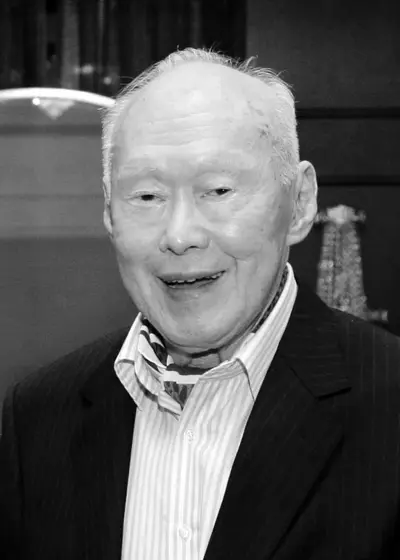
Lee Kuan Yew GCMG CH SPMJ, often referred to by his initials LKY, was a Singaporean statesman and lawyer who served as Prime Minister of Singapore from 1959 to 1990. As one of the founding members of the People's Action Party, Lee is recognised as the nation's founding father, credited with rapidly transitioning the country from a "developing third world country into a developed first world country within a single generation" under his leadership. Lee died of pneumonia on 23 March 2015, aged 91. In a week of national mourning, about 1.7 million Singaporean residents as well as world leaders paid tribute to him at his lying-in-state at Singapore's Parliament House and at community tribute sites around the country.
