Maximilien Robespierre Quotes
Any law which violates the inalienable rights of man is essentially unjust and tyrannical; it is not a law at all.
Robespierre, Maximilien. Oeuvres de Maximilien Robespierre. Vol. 9, Presses Universitaires de France, 1958, p. 469.


The Center is in Holland. Chouket is Tunisian


This famous Jefferson quotation is often used by those who argue that Jefferson’s concept of freedom and liberty was inherently and necessarily connected to the concept of God despite his strong and passionate writings advocating the separation of church and state. Opponents of that point of view, argue that the Rights of British America was a political document written to enlist and increase public support for Jefferson’s notions of freedom and liberty. At the time, as today, most Americans were deists, and they argue that just because Jefferson appealed to the popular perception of the day to promote his ideas, does not mean that a supreme being was fundamental to Jefferson’s philosophy. It is probably the case however, that Jefferson, like other founders such as John Adams, and many modern people, had different views on this subject at different times in their lives and never were absolutely sure of the existence of or necessity of a supreme being.


Baron Brougham and Vaux


Although nether he or the Sultan had made vigorous efforts to stop the massacres, he had promised the world community that Turkey would see that justice was done (See {620596} ). However, there were a few tried and one governor of a province was hanged and a few others received short jail sentences. Talaat, the worst of The Young Turks regarding the genocide, escaped to Germany. But he was tracked by a surviving Armenian who assassinated Talaat. The assassin was acquitted by a sympathetic German court which ruled that the extermination of the assassin’s family had been so traumatic that temporary insanity relieved the assassin of criminal responsibility.


What was particularly interesting about this quotation is that Pinkney was a political leader of Maryland, a slave state. He saw the injustice and immorality of slavery but like many others of our founding fathers assumed that ending slavery would infringe on the property rights of the slave holders. Others argued that there can be no right to deny others their basic rights—property and wealth are subordinate to natural rights. See {632258} and {632259} for more on this point.


He had written this at the request of Joan van der Capellen, the Dutch revolutionist, to have a Christian theological justification for revolution against the then Dutch monarchy. See {639741} and {639742}.

Character Franklin invented early in his career
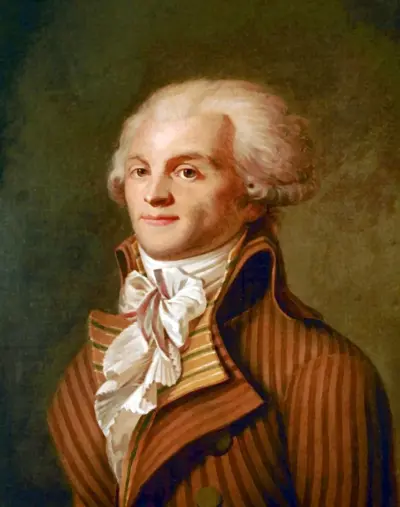
Maximilien François Marie Isidore de Robespierre was a French lawyer and statesman who was one of the best-known and most influential figures of the French Revolution. As a member of the Constituent Assembly and the Jacobin Club, he campaigned for universal manhood suffrage and the abolition both of celibacy for the clergy, and slavery. In 1791, Robespierre became an outspoken advocate for the citizens without a political voice, for their unrestricted admission to the National Guard, to public offices, and for the right to carry arms in self-defence. Robespierre played an important part in the agitation which brought about the fall of the French monarchy on 10 August 1792 and the summoning of a National Convention. His goal was to create a one and indivisible France, equality before the law, to abolish prerogatives and to defend the principles of direct democracy.
