Edward Coke Quotes
And therefore, every subject of this realme, for injury done to … by any other subject, be he ecclesiasticall, or temporall, free, or bond, man, or woman, old, or young, or be he outlawed, excommunicated, or any other without exception, may take his remedy by the course of the law, and have justice, and right for the injury done to him, freely without sale, fully without any deniall, and speedily without delay.
This quotation is a more sophisticated statement of the Magna Carta clause {583716}. Note that English law allowed redress against all other people including religions officials and government temporal officers. And everyone was entitled to justice and access to the courts including outlaws or people who have been excommunicated. In many countries these people do not have the protection of the law. This tradition allows prisoners in jail to sue the jailers for example. And imagine a person who had been excommunicated as a heretic and yet allowed to live turning around and suing clerics who were persecuting him in an Islamic nation other than Turkey.
Edward Coke, 1552-1634, English Solicitor General, Attorney General and Speaker of the House of Commons, Second Institute, 1641
Sourced by: Eigen's Political and Historical Quotations

Sealed under duress and later repudiated by the King with Papal assistance.

Sealed under duress and later repudiated by the King with Papal assistance

Sealed under duress and later repudiated by the King with Papal assistance


Three Chicago Aldermen had marched on an art school demanding that a painting they found offensive be removed from public display. The police seized the painting, prompting a lawsuit.


This quotation shows that “due process” was an important principle for the colonists long before the American Revolution and the Constitution and Bill of Rights. Rights. Connecticut and New York passed similar laws after Massachusetts.


The Senator was arguing against a bill to correct an aspect of the immigration law where infants and very young clildren are broght to the United States by parents who entered illegally. The children grow up in the United States—the only country and home that they have ever known. American law required that they be deported to “their countries” which they have no memory of and many do not even speak the language or know the culture. Sessions, is an example of the view that law defines justice. Therefore laws cannot be unjust nor can enforcing the law. Opponents point out that even in the United States we have, in earlier times, “enforced the law” which we came to regret and see as an injustice. The Fugitive slave laws, the Southern racial discrimination laws, and the law allowing Japanese American Citizens to be interned and lose their land during WWII are a few examples of laws, the enforcement of which is seen by most Americans as having been unjust. The execution of “witches” in early America was in conformity with the law.

“Familia” in Latin meant in this context, the community or the citizens as opposed to the officials, The Bishop determined the former was under attack by the officials who in the probating of wills and estates would take bribes or levy taxes under “laws” that they would make up on the spot bilking the rightful inheritors of the property and wealth of the deceased. The principle that laws and regulations must be written down in advance and not otherwise, is a fundamental part of Western law today, But as this quotation shows, it was not always such.


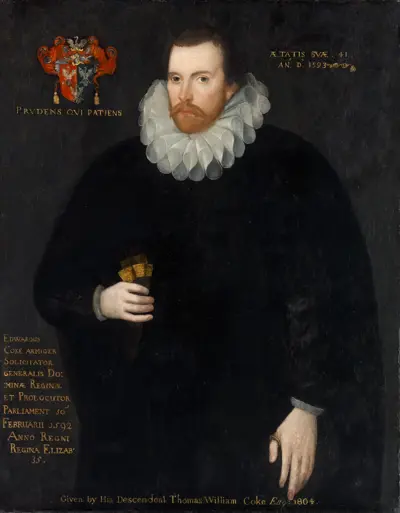
- Born: February 1, 1552
- Died: September 3, 1634
- Nationality: English
- Profession: SL
Sir Edward Coke SL was an English barrister, judge, and politician who is considered to be the greatest jurist of the Elizabethan and Jacobean eras.
