Ralph Waldo Emerson Quotes
America. Emigration. In the distinctions of the genius of the American race it is to be considered that it is not indiscriminate masses of Europe that are shipped hitherward, but the Atlantic is a sieve through which only or chiefly the liberal, adventurous, sensitive, America-loving part of each city, clan, family are brought. It is the light complexion, the blue eyes of Europe that come: the black eyes, the black drop, the Europe of Europe, is left [in Europe].
Ralph Waldo Emerson, 1803-1882, Poet & Essayist, Journal, June 1851
Sourced by: Eigen's Political and Historical Quotations


Bourne was one of the first writers with a national audience to question the classic but never real “melting pot” theory of immigration and suggest the “salad” model though he never used the term.


Gustav II Adolph. The colony would also exclude slavery, and to make a home for the oppressed of all Christendom. Essentially this was the first plan for multicultural diversification of American immigration. The 30 Years War put the project on hold until after the king’s death and it was not until 1638 that Swedish ships sailed for what they called “New Sweden” landing at Wilmington, Delaware, calling it Christina.


The eventual demise of the French Colonial Empire was predicted by almost all scholars and statesmen except the French. It would be after the Second World War when the French were proved to have been delusional on this point.

He was agreeing with the Right Wing racist Dutch politician Geert Wilders that one of the dangers of immigration of different races and ethnicities is that their children would not be capable or able to contribute to America or in his view make America Great Again as it has been diminished by all these immiogrant babies of the last few generations. There are very few areas of civilization where America is not greater today than ever before.

In 1936 there was a right wing, nativist faction that was campaigning against foreigners, not unlike in 2016.
Bourne was one of the first writers with a national audience to question the classic but never real “melting pot” theory of immigration and suggest the “salad” model though he never used the term.


Most immigration reformers want to open immigration more widely. Ward wanted immigration restricted to certain ethnicities and limited. He wanted a uniformity of assimilation and not diversity.


This is the origin of the “melting pot” term. Although British, Zangwill wrote this play for America and it was first produced in Washinton DC with Theodore Roosevelt in attendance. The theme was just the concept that most Americans think of relative to the large immigration of so many peoples to America.
This is a complaint similar to that made by anti-immigrant Americans. France, like most other countries of the world, has never had the large scale immigration of today, nor have they had such a large proportion of the same ethnicity at once—in this case, Muslim North Africans. There were never, before the last decades, enough immigrants of any ethnicity in France to have a choice of maintaining their traditional languages and culture and not learning French or otherwise assimilating. America, in contrast, had large immigrations of different ethnicities, and despite the erroneous beliefs of immigration opponents, these blocs of immigrants have wherever there was sufficient density—usually cities, they maintained their old language and other customs. However, their children and the next generation in almost all cases have abandoned the language and many of the customs of the old country. This was true of the Germans, the Irish, the Italians, the European Jews, the Russian Jews, the Scandinavians’, and the Hispanics with their different cultures.


Although generally a supporter of immigration, he began to oppose it when the very large numbers of immigrants who were ethnically and culturally different began to enter the United States. Northern Italians were OK but the Southern Italians were from a different social class. German Jews had made great contributions to America but the Russian Jews were peasants and serfs. Polish immigrants also. Walker was worried that for the first time in America there would be a social class division as the historical difference between rich and poor in America he believed was within ethnic groups and not between them.
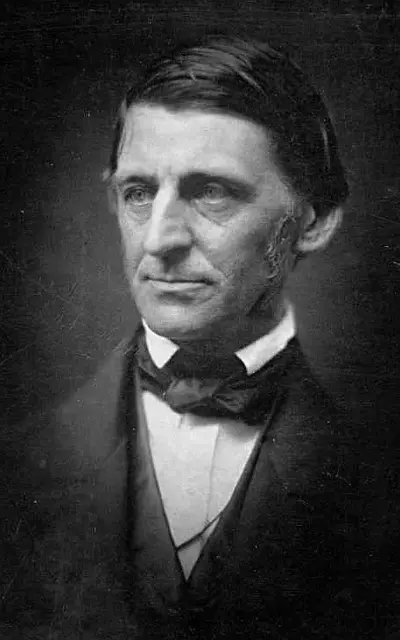
Ralph Waldo Emerson, who went by his middle name Waldo, was an American essayist, lecturer, philosopher, abolitionist and poet who led the transcendentalist movement of the mid-19th century. He was seen as a champion of individualism and a prescient critic of the countervailing pressures of society, and he disseminated his thoughts through dozens of published essays and more than 1,500 public lectures across the United States.
