Herbert Spencer Quotes
All socialism involves slavery.... That which fundamentally distinguishes the slave is that he labors under coercion to satisfy another's desires. The relation admits of many gradations. Oppressive taxation is a form of slavery of the individual to the community as a whole. The essential question is -- How much is he compelled to labor for other benefit than his own, and how much can he labor for his own benefit?
Spencer, Herbert. The Man Versus the State. Williams and Norgate, 1884, p. 34.


The Supreme Court had ruled that the Constitution prohibited the Federal Government from regulating conditions of child labor. A Constitutional amendment was passed by Congress and submitted to the States for ratification. That amendment is still the legal basis for all the Federal involvement in child labor. However there were many opponents. The idea of telling an employer that he could not work an 8 year old child for 14 hours a day was actually considered Communistic by some right wing elements. This quotation is famous for two reasons: First, it illustrates the extreme view against any kind of regulation of business that a strong minority held at the time. Second, this was a statement by a Roman Catholic Cardinal. The Catholic has generally been one of the progressive forces for labor reform (with the exception of racial discrimination and slavery) in the United States. Most modern Catholics are very surprised that a Cardinal actually issued such a Pastoral Letter—especially since he had been progressive on other issues {627510}.

As a result of the programs and philosophy he expounded, Leontiev joyously predicted:

This was the first use of the word “socialism”.

The Income tax had been ruled Constitutional by the Supreme Court in 1881, but the then “new” Court—the one that would render the Plessy v. Furgeson decision—was a more conservative one. By a 5-4 partisan decision, the Supreme Court reversed itself and killed the income tax until a Constitutional amendment could be passed 19 years later in 1913.


This fascinating quotation is very frequently quoted out of context. For example even in modern times some Southern slavery apologists quote this passage stating that Adams saw no moral difference between slavery and employment of the lower classes. And anti-capitalists have claimed that this was an attack on capitalism as no better than slavery for many workers. Neither is true. The debate was on the head taxes that states should pay to the central government. Southerners were claiming that they should not have to pay per person taxes on slaves. Adams position was that they should pay in that there is no practical difference in the work and working conditions very often. If slaves should be exempted from the head tax, so should the poor, lower class workers like the fisherman in New England. He always maintained at huge moral difference between a poor free worker and a slave even thought their working conditions might be similar.


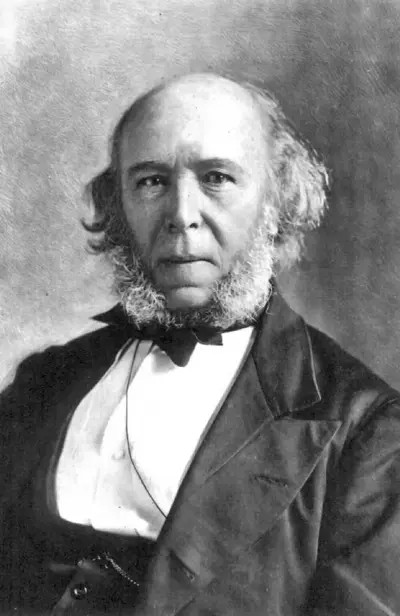
Herbert Spencer was an English philosopher, biologist, anthropologist, and sociologist famous for his hypothesis of social Darwinism whereby superior physical force shapes history. Spencer originated the expression "survival of the fittest", which he coined in Principles of Biology (1864) after reading Charles Darwin's On the Origin of Species. The term strongly suggests natural selection, yet Spencer saw evolution as extending into realms of sociology and ethics, so he also supported Lamarckism.
