Akilisi Pohiva Quotes
All monarchies have a common characteristic...and that is stubbornness.
Tonga was one of the few nations controlled by a king.
Akilisi Pohiva, Tongan Newspaper Editor & Elected Legislator, Quoted in Pacific Magazine, 2007
Sourced by: Eigen's Political and Historical Quotations


After the King’s appointment in 1921 she “advised” him on establishing this regime and operating the government. At a time that women could not even vote in England, Bell was a kingmaker and major power in an area of the world that was much more sexist than England at the time.


Barstow the Democratic Governor who had no serious opposition in 1853 found himself challenged for reelection by Coles Bashford of the new Republican Party. The Board of Canvassers reported that Governor Barstow had won reelection but by less than 200 votes in the whole state. The Republicans charged that there had been fraud in some of the rural districts and petitioned the Wisconsin Supreme Court which ruled that nonexistent precincts had indeed voted for the Governor. Barstow however refused to recognize the decisions of the court claiming that the court had no jurisdiction over the Board of Canvassers who were part of the executive branch. The Republicans held their own inauguration and two men claimed to be Governor. But the Governor claimed that the state constitution did not give the court any authority to deal with the crisis, He even called out the State Militia to maintain his office and intimidate the Supreme Court and keep the “other governor” from the state house. Nonetheless the court ruled that even the Governor had to obey the law and the Supreme Court would determine what the law was. Barstow finally “resigned.” See {587915} & {587917}.


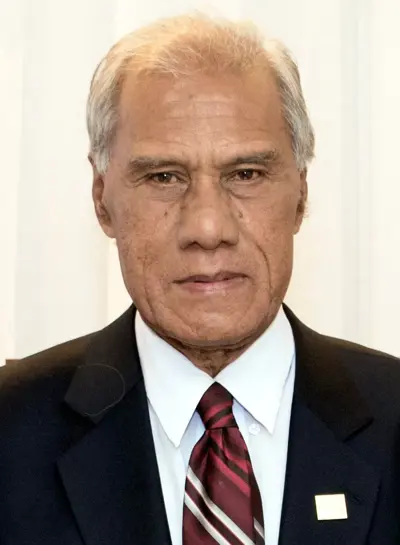
Samiuela ʻAkilisi Pōhiva was a Tongan pro-democracy activist and politician. Pohiva, the leader of the Democratic Party of the Friendly Islands (DPFI), served as the Prime Minister of Tonga from 2014 to his death in 2019. He was only the fourth commoner to serve as Prime Minister (after Shirley Baker in the 1880s, Siosateki Tonga in the 1890s and Feleti Sevele in the 2000s), and the first commoner to be elected to that position by Parliament rather than appointed by the King.
