Franklin Pierce Quotes
After the White House, what is there to do but drink?
Franklin Pierce, 1804-1869, 14th President of the United States (Democrat, NH), Quoted in New York Times, June 29, 2014
Sourced by: Eigen's Political and Historical Quotations


The distinction between recreational drinking and heavy drinking is a subtle one and rarely made until modern times. Most leaders who would not have heavy drinkers in positions of responsibility were usually themselves teetotalers and they were very rare. Heavy drinkers and alcoholics have been in positions of responsibility throughout history including modern times—eg House Ways & Means Chairman Wilbur Mills and Russian President Boris Yeltsin. Peter was unusual in that he made the distinction.

Massachusetts Bay Colony Governor John Winthrop

Unfortunately, drinking has been the scourge of Russia over the years. With one of the highest alcoholism rates in the world, Russia’s average lifespan has always been shortened by alcohol.

Aeneas Sylvius Piccolomini. Early in his career, as Secretary to the Emperor, he was assigned to oversee the education of the young king of Bohemia. Piccolomini’s advice of temperance was not at all based on theological reasons as drinking was rampant, even among the clergy. Also, he recognized the major effect of peer pressure on teenagers as it affects drinking behavior.
The graphic for this quote is the original illustration from the article. German WWII propaganda characterized Churchill as a hugly overweight, ugly, drunk. Churchill was a relatively heavy drinker of alcohol.

Samuel Langhorne Clemens, 1835-1910. The Congressmen who voted for Prohibition in the next century had not read or believed this quotation of Twain’s.
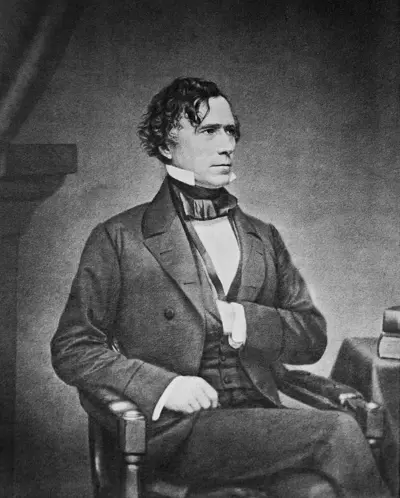
Franklin Pierce was the 14th president of the United States, serving from 1853 to 1857. A northern Democrat who believed that the abolitionist movement was a fundamental threat to the unity of the nation, he alienated anti-slavery groups by supporting and signing the Kansas–Nebraska Act and enforcing the Fugitive Slave Act, yet these efforts failed to stem conflict between North and South. The South eventually seceded and the American Civil War began in 1861.
