Ireland Quotes
Act to Encourage Protestant Strangers to Settle in Ireland
Ireland was then under English Control but the majority of the population were Roman Catholic. The Protestants wanted to bring more “balance” to the country. They were so anxious to dilute the Catholic population that they considered Jews as Protestants for this purpose and many of them immigrating to Dublin created the foundation of the Irish Jewish population in modern Ireland.
Irish Law, Passed in 1662
Sourced by: Eigen's Political and Historical Quotations


Orangemen were the ulta Protestant Nationalists of Northern Ireland. Both Protetants and Catholics had their extremists who publicly spewed their hate, desire for exclusivity, and insults with little moderation from moderates who always risked retaliation from the extremists even of their own religion, not unlike the situation of the beginning of the 21st century, where Muslim moderates were cowed and intimidated by the religious Islamic extremists.


It took only 10 days after the First Continental Congress met for religious bigotry to arise. After hundreds of years of Catholic/Protestant strife, each sect looked upon the other, not only as theologically wrong, but dangerous to the liberty of the other. Unfortunately, the organied religions had acted so badly towards other religions, that everyone was justified in fearing the other religions. This quotation illustrates a then typical attitude of many American Protestants that the Catholic Church was a threat to national security. Ironically, in modern times, anti-Catholic bigots use this quotation to demonstrate that the United States was founded as a Christian Protestant nation—not a general Christian nation. A small, vicious anti-Catholic sentiment still exists, usually by a minority of right wing Protestant religious fundamentalists. Protestant England had just repealed the laws making Catholicism illegal, but this was regarded at that time as intolerable for the new America. This was one of the disputes which that the Founding Fathers were faced with later and one of the reasons that they were so absolute in the need for the 1st Amendment.

Kennedy was being hurt be fears that as a Catholic, he would be beholden to the Pope and the Catholic Bishops. There were many protestants who believed that the Catholic Church was antithetical to democracy and some who even believed that Catholicism was the religion of Satan. Kennedy decided to confront the issue head on.

She was referring to the Muslim immigrants who were then coming into Europe in large numbers. Europe in general, and Italy in particular, have never had the American experience of assimilation of large numbers of immigrants, and many Muslims came to Europe just for the economic opportunities but did not like or respect the culture or the values. Some even preached hatred of the Christian West and fomented terrorism. This was different from America where Muslim immigrants arrived and despite the difficulties of new immigrants most thrived and were able to assimilate yet maintain their religion and cultural customs. At the same time many American Islamic immigrants represented the more modern Islamic which valued freedom and pluralism and unlike most Muslim nations of today, appreciated the advanced, modernistic, tolerant Islam of 1000 years ago when tolerance and freedom of thought within an Islamic framework made some Muslim countries the most advanced in the world.


Although Jefferson was a strong immigration enthusiast, he and others were concerned about the ghettoization. The early German immigrants did not universally adopt English, just as today’s immigrants do not all. This was a concern of Americans since the first immigrations. Yet it has always occurred despite concerns about it. However, the second and third generations all become fluent and literate in English.


Input on the question of immigration, said while a scholar at Princeton

This is the origin of the “melting pot” term. Although British, Zangwill wrote this play for America and it was first produced in Washinton DC with Theodore Roosevelt in attendance. The theme was just the concept that most Americans think of relative to the large immigration of so many peoples to America.

This is a complaint similar to that made by anti-immigrant Americans. France, like most other countries of the world, has never had the large scale immigration of today, nor have they had such a large proportion of the same ethnicity at once—in this case, Muslim North Africans. There were never, before the last decades, enough immigrants of any ethnicity in France to have a choice of maintaining their traditional languages and culture and not learning French or otherwise assimilating. America, in contrast, had large immigrations of different ethnicities, and despite the erroneous beliefs of immigration opponents, these blocs of immigrants have wherever there was sufficient density—usually cities, they maintained their old language and other customs. However, their children and the next generation in almost all cases have abandoned the language and many of the customs of the old country. This was true of the Germans, the Irish, the Italians, the European Jews, the Russian Jews, the Scandinavians’, and the Hispanics with their different cultures.
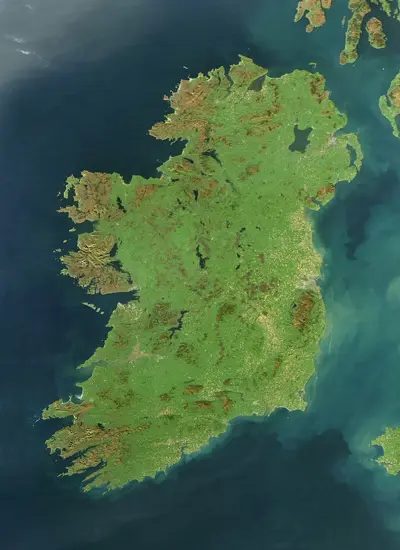
Ireland is an island in the North Atlantic. It is separated from Great Britain to its east by the North Channel, the Irish Sea, and St George's Channel. Ireland is the second-largest island of the British Isles, the third-largest in Europe, and the twentieth-largest on Earth.
