Ross Douthat Quotes
Absent a national church, Christianity has frequently provided an invisible mortar for our culture and a common vocabulary for our great debates.
Ross Douthat, Editor, Columnist & Writer, Breaking Faith, 2012
Sourced by: Eigen's Political and Historical Quotations


In September of 2005 a Danish Newspaper published some political cartoons showing the hypocrisy of some Muslims who use Islam to justify murder of innocents and terrorism. Months later, in January of 2006 many in the Middle East protested vehemently and Muslim riots broke out because the Prophet Muhammad's visage was depicted against Islamic tradition. Many Muslim nations started a boycott against Denmark. Many Muslim leaders claimed that insulting religion was an “abuse” of freedom of speech including those from nations which regularly publish material that is virulent against Christians and Jews.


Rev. Falwell was so struck with the “moral majority” phrase that it became the name of their organization.

The people of the Book refers to Jews and Muslims. This passage of the Koran is used to justify ecumenism with Muslims integrated with Jews and Christians. The Koran consists of Muhammed’s sayings, and he himself had opinions about Jews and Christians that differed from time to time. So although this passage signals a tolerant religion, in other places Muhammed preached violence against the people of the Book. At first Muhammed and his followers expected to see the people of the Book adopt Islam as their religion. When they did not, relations deteriorated somewhat.

His protest was focused on Middle East policies which he believed did not value the lives of Muslims as highly as Christians and Jews. The irony of this protest is that United States policy claims to value all life equally as do virtually all industrialized democracies. Omeish however is unusual among world Islamic leaders and politicians in that he values Christian and Jewish life as much as Muslim. Most, typically value Muslims almost exclusively and many advocate the killing of Christians and Jews.

There were several dynamics that contributed to the change. Younger Americans of all persuasions were much more tolerant than previous generations. A much larger proportion of Americans did not identify with any religion. The many Christian sects were very diverse and almost never presented a unified view of exactly what were Christian values for any issue. The tactics of the religious extremists had alienated many people from all religious efforts to shape, much less dominate, the norms and culture. Finally, the Courts and the Politicians began to take the separation of church and state much more seriously than and been the case in many past generations.

Medved, a Jew, maintained that as America became more interested in Christianity, there would also be more interest in Judaism, and true Christianity—American Christianity—which would not be anti-Semitic as many earlier Christian movements had been. Most Jews disagreed preferring a strict separation of church and state. While it may be true that some Christian groups are favorably disposed to Jews, historically must American Christian groups have been supportive of anti-Semitic activities in the United States.


Watchtower Bible and Tract Society of New York

Head of the Sikh Religion. His teaching was that deeds determined the man, not the professed belief and that the existing religions turned man against man.

One remarkable aspect of this quote is that most Western nations have the exact same perception he claims the Islamic word does of what the West is doing. While the Western nations think the defense is necessary and desirable, the Muslim nations fundamentally believe that Christianity and Judaism should and will be supplanted by Islam. To the Islamic fundamentalist religion is a zero sum game. Every person in the world who is not a Muslim is an attack on Islam in that God wants all to follow Islam and wants the faithful to make it so.
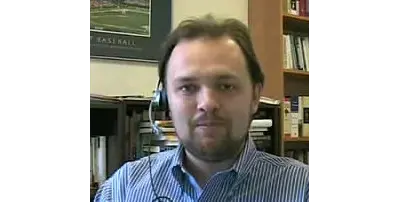
Ross Gregory Douthat (/ˈdaʊθət/) (born 1979) is an American conservative political analyst, blogger, author and New York Times columnist. He was a senior editor of The Atlantic. He has written on a variety of conservative topics, including the state of Christianity in America and "sustainable decadence" in contemporary society.
