Thomas Ringland Stockdale Quotes
A zoo does not sound like republicanism. It echoes like royalty
The Smithsonian had started a “Department of Living Animals” and had 172 at the time whereas earlier all animals were stuffed. At the time no one was quite sure whether or not there would be any public interest in a zoo. This initial request for $200,000 to buy property on which to place the zoo was turned down as historically zoos were created by royalty and the very rich and didn’t seem democratic to many members of the House. Others however, saw the role of democracy as bringing to ordinary people what had historically been available only to royalty and the wealthy. That view eventually prevailed in America, and the National Zoo is a destination for millions of Americans and foreign tourists. In the next session of Congress, the House reversed itself and voted the appropriation for the National Zoo. See {629320}.
Thomas Ringland Stockdale, 1828-1899, U. S. Congressman (Democrat, MS), Statement when opposing the first requested appropriation for a National Zoo associated with the Smithsonian Institution, 1888
Sourced by: Eigen's Political and Historical Quotations

The Smithsonian in 1888 had started a “Department of Living Animals” and had 172 at the time whereas earlier all animals were stuffed. At the time no one was quite sure whether or not there would be any public interest in a zoo. This initial request for $200,000 to buy property on which to place the zoo was turned down as historically zoos were created by royalty and the very rich and didn’t seem democratic to many members of the House. Others however, saw the role of democracy as bringing to ordinary people what had historically been available only to royalty and the wealthy. See {629321} . The Speaker was not an enthusiast for the zoo and the House had voted it down in the previous session, but there had been a surge in popular opinion and Congressmen had been extensively lobbied by advcates for the upper and working classes. The Speaker was a realist as the quotation indicates, but he was not as tactful as later speakers were.

This quotation is a great demonstration of how much wiser and the better politician of all the crowned heads of Europe that Queen Victoria was. There were stirrings of freedom and desire for parliamentary government throughout Europe. Queen Victoria, even though and perhaps because she was a young woman, had a great feel for fairness and reasonableness and had read a great deal of history. There were some radical red socialists calling for complete radical revolution scaring European Royalty profoundly. They reacted very conservatively and with reaction, reverting to more tyrannical practices of the past urged in that path by very conservative, right wing advisors. Victoria also had little respect for some of the monarchs who had little interest in their people and much with their personal power and wealth. In the end, it was England which was the only nation which never had a serious radical socialist / communist threat, and that had much to do with Victoria’s political acumen and wisdom.


While France was in the midst of a violent revolution, the American debate was on the power and prestige of the Presidency. Then Vice President John Adams was a proponent of a strong executive. Most others were not.

In the election of 1800, the Jeffersonian republicans were pitted against the John Adams Federalists. The latter had seen the revolution as against the excesses of England and King George and not necessarily against the notion of a class society where government served the interests of the upper class—a political battle that is still with us to some extent. The Jewish religion generally recognizes no right of theocratic authority of one man over others with all to follow the laws of God, was theologically very republican. Rabbis were teachers and had no theological or civil authority. To Nones and many other Jews the Jeffersonian ideals were very close to their religious and cultural tradition and to the extent that there has been a party of the classes and a party of the masses, most Jews had gravitated to the latter with the exception of merchants, bankers and others whose economic interests were with the right of center party.

De Tocqueville was generally concerned about what he saw as an inherent conflict between freedom and equality. Efforts to produce equality can lead in some cases to impingements on some freedoms or rights. Unlimited free rights can produce inequality and a de facto autocracy. Even in modern times America is struggling to find a proper balance.


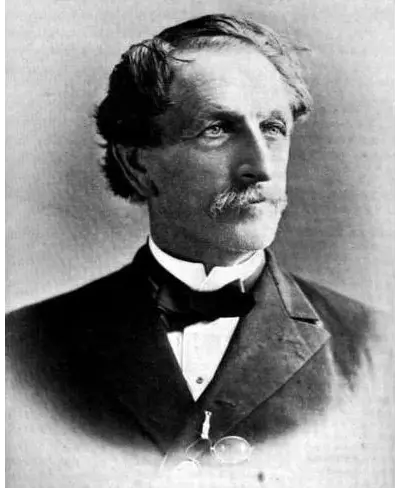
- Born: March 28, 1828
- Died: January 8, 1899
- Nationality:
- Profession:
